
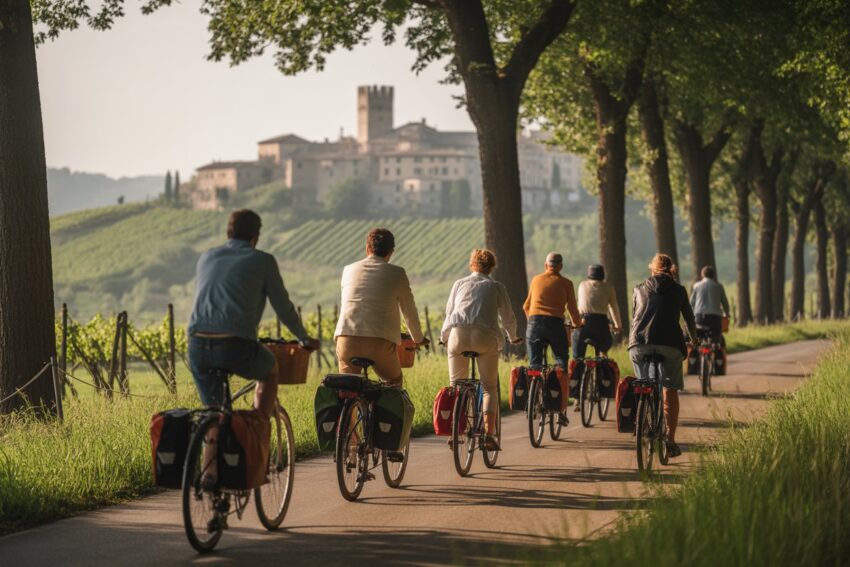

For years, the conversation around European tourism has been dominated by one word: overtourism. From the crowded canals of Venice to the protest-filled streets of Barcelona, the traditional model of “mass tourism” has reached its breaking point. But on January 20, 2026, a new voice entered the room with a radically simple solution—to slow down, step out of the bus, and experience the continent at a human scale.
The official launch of the Active Tourism Coalition marks a turning point in European policy. Led by the European Cyclists’ Federation (ECF) and supported by 15 civil society and industry organizations, this alliance is calling for a fundamental shift: making cycling, walking, and hiking the strategic pillars of the upcoming 2026 European Sustainable Tourism Strategy.
More Than Just a Hike: The Power of Active Travel
What exactly is “Active Tourism”? It’s the art of moving through a landscape using your own power. It is the traveler who chooses a three-day bike trip along the Danube over a one-hour flight, or the hiker exploring the lesser-known trails of the Pyrenees.
The Coalition argues that these activities shouldn’t be niche hobbies—they should be the cornerstone of how Europe welcomes the world. Why? Because active tourism solves the “Big Three” problems of modern travel:
- Decarbonization: It is the ultimate low-carbon way to travel.
- Economic Distribution: Unlike cruise ships or all-inclusive resorts, active travelers tend to spend more in small, rural villages and locally-owned cafes.
- Health & Wellbeing: It promotes physical activity for the traveler and reduces the noise and air pollution for the resident.
The Economic Engine: 44 Billion Reasons to Support Cycling
Critics often dismiss active tourism as a small-scale endeavor, but the data tells a different story. In 2012, cycling tourism alone was estimated to generate €44 billion annually in Europe. By 2025, that number has only grown as the “Adventure Travel” sector evolved into a trillion-dollar global market.
“Active tourism should be the cornerstone of the European Sustainable Tourism Strategy,” said Laurianne Krid, CEO of the ECF. “By encouraging tourists to move through regions by bike or on foot, it supports healthier lifestyles and stronger local economies.”
The Coalition’s Four-Point Plan
The Active Tourism Coalition isn’t just asking for “more bike lanes.” They have presented a sophisticated roadmap for EU institutions to follow:
- Integration: Active travel must be part of the “multimodal” transport chain. This means better “last-mile” solutions—making it easy for a traveler to take a train to a regional hub and find a high-quality bike rental or a clearly marked trailhead waiting for them.
- Visibility: The coalition wants to leverage the EuroVelo network (Europe’s massive system of 17 long-distance cycle routes) as a primary symbol of “Brand Europe.” They are calling for high-quality, open data to be integrated into EU tourism hubs so travelers can plan their “active” trips as easily as they book a flight.
- Governance: Sustainable tourism cannot be managed from a boardroom in Brussels alone. The coalition advocates for frameworks that bring together local NGOs, land managers, and residents to ensure that tourism development protects the landscape instead of consuming it.
- Investment: Significant funding is needed to maintain trails, greenways (Vías Verdes), and E-paths. The coalition argues that this isn’t just an “infrastructure cost”—it’s an investment in European resilience.
Rebalancing the Map
One of the most humanizing aspects of active tourism is its ability to “de-seasonalize” travel. While beaches are packed in July, a hiking trail in the Black Forest or a cycling route in Tuscany can be just as rewarding in May or October. By spreading visitors across the calendar and the map, the Active Tourism Coalition aims to give “breathing room” back to overcrowded cities while breathing new life into rural areas that have been overlooked for decades.
A Call to Action for 2026
With the release of the official Sustainable Tourism Strategy imminent from the European Commission, time is of the essence. The Active Tourism Coalition showcases a synchronized coalition of 15 constituents from cycle federations to outdoor sport bodies: The future of Europe is not a packed airport, but a dispersed Europe with numerous flowing itineraries.
For the traveller, this means a future where the journey is just as important as the destination. It’s a future where you don’t just “visit” Europe. You sense it with every step and witness it from the bike.
The post Active Tourism Coalition 2026: Shaping the Future of Europe’s Sustainable Travel Agenda appeared first on Travel And Tour World.
