
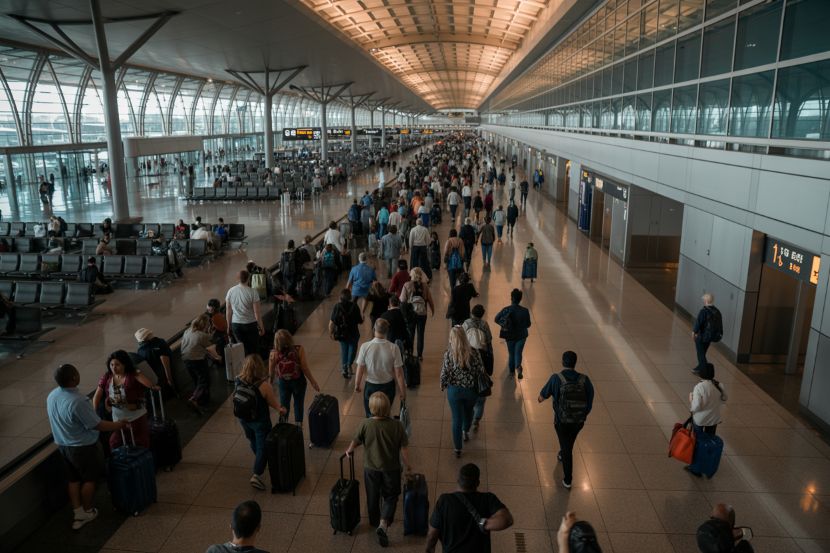

While international air travel is still up and running after the pandemic, two airports, Atlanta Hartsfield-Jackson International and Dubai International, have already made it to the top of the most crowded airport list for 2025. These major tourist centres still have their status as the world’s most crowded airports by available departing seats, an important metric reflecting the travel industry’s growth. Their rankings are like a prophecy for the future of global travel, as each of the airports has more seats, thus making their spots in the airspace even more solid.
Atlanta Leads Global Travel Hubs with Over 63 Million Seats
Atlanta Hartsfield-Jackson International (ATL) has successfully retained its status as the world’s busiest airport for the third consecutive year. The airport’s capacity in 2025 reached 63.1 million seats, a 1 percent increase over the previous year and bringing it back in line with pre-pandemic levels. This notable growth in seat capacity highlights ATL’s crucial role in both domestic and international air traffic, reinforcing its position as a central hub for global connectivity. As U.S. air travel surges, the airport continues to serve as the key entry point for millions of passengers.
Dubai Follows Close Behind, With Exceptional Growth
Dubai International Airport (DXB) takes second place with a total of 62.4 million available seats, reflecting a 4 percent increase year on year. This growth also marks a 16 percent jump from pre-pandemic levels in 2019. The UAE airport’s remarkable expansion reflects Dubai’s growing prominence as a global transit hub, catering to long-haul travelers from all corners of the world. Known for its extensive network of international routes, DXB remains a major player in the Middle East and beyond, helping facilitate seamless connections across the globe.
Tokyo Haneda Maintains Solid Position
Securing third place in the global rankings is Tokyo Haneda Airport (HND), with 55.4 million departing seats. This marks a slight increase of 1 percent over the 2024 capacity, as it continues to maintain its position as Japan’s busiest international gateway. Haneda’s consistent performance is a testament to Japan’s resilience in tourism and business travel recovery, which has been robust, aided by Japan’s proactive approach to restoring its aviation infrastructure.
U.S. Airports Show Strong Presence in the Top 10
The United States continues to be a major force in the global aviation sector, with four airports ranking in the Top 10 for busiest airports by seat capacity in 2025. These include:
- Dallas/Fort Worth International (DFW): Holding the sixth position with 51.2 million seats, despite experiencing a 1 percent decline compared to 2024. However, the airport has seen a 17 percent increase compared to pre-pandemic levels in 2019.
- Chicago O’Hare (ORD): With a substantial 8 percent increase from the previous year, Chicago O’Hare rose to the eighth spot, with 50.6 million seats, matching pre-pandemic capacity.
- Denver International (DEN): Dropping slightly to 10th place, Denver remains a crucial U.S. hub, registering 49.5 million seats, a 24 percent increase from 2019 levels.
European Airports Maintain Strong Positions Despite Global Shifts
In Europe, the busiest airports almost mirrored last year’s rankings, with London Heathrow (LHR) maintaining the lead. Heathrow served 52.1 million passengers in 2025, increasing 1 percent year on year and 4 percent from 2019.
Meanwhile, Istanbul Airport (IST) solidified its rise as a major global aviation hub, securing second place in Europe with 51.5 million seats, a 6 percent increase from 2024 and 22 percent higher than in 2019.
Paris Charles de Gaulle Airport (CDG) ranked third, despite a slight decline compared to 2019. However, with 43.2 million seats, CDG remains an essential European gateway for international travellers.
A Look at Rising Hubs: Istanbul Sabiha Gokcen and Munich’s Decline
A notable change in the rankings this year was the rise of Istanbul Sabiha Gokcen Airport (SAW), which jumped from 11th to ninth in 2025, thanks to a 15 percent capacity growth. This shift saw Munich Airport (MUC) fall to 10th place despite its own strong capacity growth of 5 percent year on year.
Impact on Global Travel
The growth in seat capacity at these major airports reflects the ongoing recovery and expansion of international travel. As hubs like Atlanta, Dubai, and Tokyo continue to enhance their flight networks, global connectivity improves, which, in turn, impacts the flow of both leisure and business travelers. Airlines are adding new routes and frequencies, and airport infrastructure is evolving to accommodate the growing demand.
The Future of Aviation and Global Travel Connectivity
The positioning of Atlanta, Dubai, and Tokyo Haneda is an indicator of increasing air travel demand worldwide, as well as their corresponding ability to meet the growing demand. These airports are not only supporting domestic and international flights but also playing a pioneering role in the development of tourism and worldwide business travel. So, the more travellers are looking to fly, the more these airports will be important as the main links guaranteeing smooth travel for millions of travellers all around the world.
The post Global Aviation in 2025: Atlanta, Dubai, and Tokyo Hubs Drive Tourism Growth, All You Need To Know appeared first on Travel And Tour World.
