
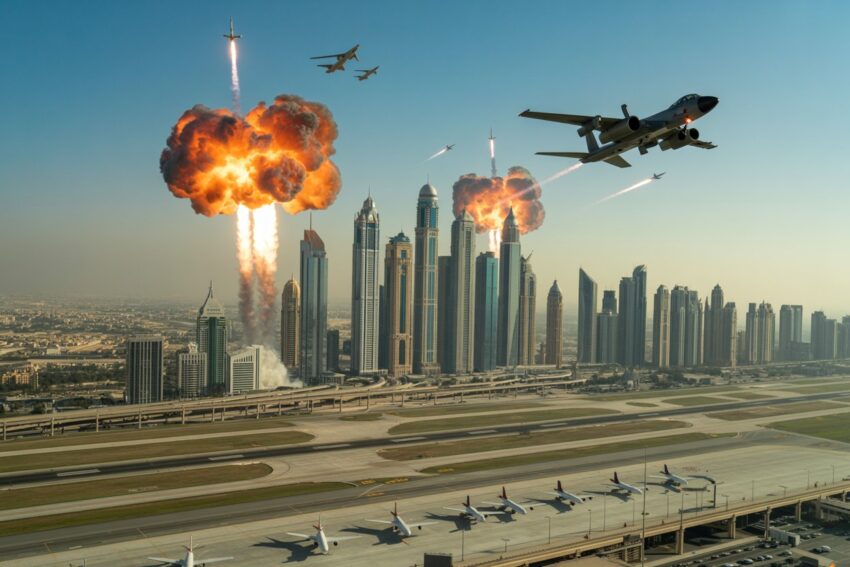
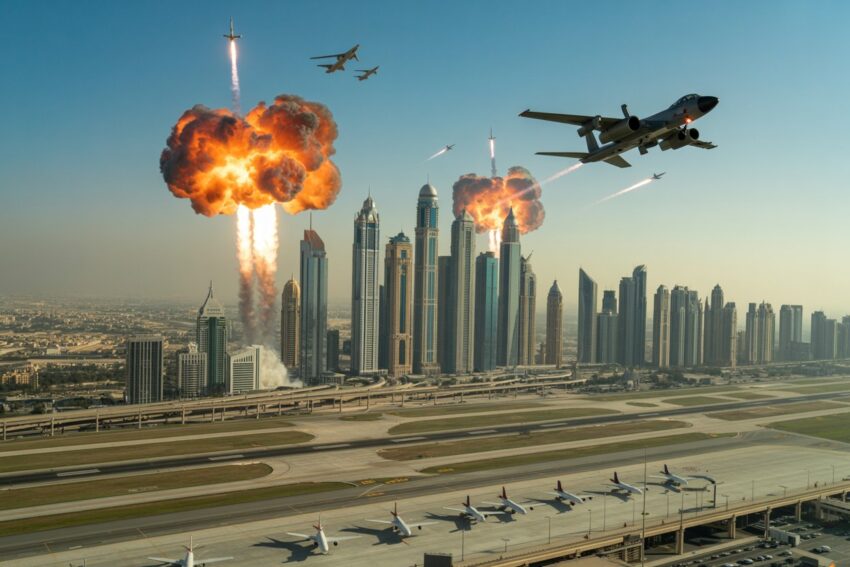
The US-Israel-Iran War Update is sending shockwaves across global aviation and tourism networks as an Iranian Drone Blitz Rocks Dubai and Gulf as Explosions Echo and Flights Collapse Across Middle East, triggering panic across one of the world’s busiest travel corridors. In this rapidly unfolding US-Israel-Iran War Update, reports confirm that an Iranian Drone Blitz Rocks Dubai and Gulf as Explosions Echo and Flights Collapse Across Middle East, forcing authorities to activate powerful air defence systems while airports, airlines and travellers struggle to respond to the escalating crisis. Meanwhile, aviation leaders across US travel, the US tourism Sector, the USA, and the wider Americas are closely watching the situation because the Gulf region remains a crucial gateway for global air connectivity.
However, the situation is intensifying by the hour. The US-Israel-Iran War Update now highlights how an Iranian Drone Blitz Rocks Dubai and Gulf as Explosions Echo and Flights Collapse Across Middle East has already triggered airport disruptions, airspace alerts and widespread flight cancellations across the Middle East. At the same time, airlines linked to US tourism, US travel, the USA, and the broader Americas are monitoring developments as aviation routes connecting continents face uncertainty.
As the US-Israel-Iran War Update unfolds further, and as an Iranian Drone Blitz Rocks Dubai and Gulf as Explosions Echo and Flights Collapse Across Middle East continues to dominate headlines, the implications for aviation, global travel and the US tourism Sector could be enormous. Travel And Tour World urges readers to continue reading to understand the deeper impact of this unfolding crisis.
The Middle East was thrust into a new phase of turmoil as missile and drone strikes shook major Gulf cities including Dubai and Doha. Loud explosions echoed across the region as air defence systems intercepted incoming projectiles launched from Iran. The escalating confrontation triggered alarm sirens, emergency alerts and major aviation disruptions, creating a tense atmosphere across the Gulf while governments scrambled to protect citizens, residents and travellers.
The conflict rapidly expanded beyond isolated incidents. Missile interceptions, drone strikes and military retaliation spread across multiple countries, including the United Arab Emirates, Qatar, Saudi Arabia and Kuwait. The intensifying situation forced airport closures, flight cancellations and emergency evacuations, turning the region’s usually bustling aviation hubs into zones of uncertainty.
If you need to contact us, please use our official support channels below. Our team is responding to a high volume of enquiries and will respond as soon as possible.⁰⁰
WhatsApp: https://t.co/tskk4G40nT⁰⁰
Live Chat: https://t.co/GzPECOViiA⁰ ⁰For a direct response, please…
— DXB (@DXB) March 7, 2026
Authorities confirmed that their air defence systems successfully intercepted numerous missiles and drones targeting strategic locations. However, the dramatic explosions, smoke plumes and airport disruptions illustrated how rapidly the conflict was spreading across one of the world’s most vital transport corridors.
Dubai and Gulf Cities Shaken by Explosions and Missile Interceptions
Dubai experienced a series of loud explosions as Iranian missiles and drones approached Gulf airspace. The United Arab Emirates Ministry of Defence confirmed that air defence systems were actively intercepting ballistic missiles and hostile drones aimed at the country.
Residents across the city reported hearing powerful blasts, while witnesses observed flashes in the sky as defence systems engaged incoming threats. Authorities reassured the public that the sounds were the result of interception operations rather than direct impacts.
Meanwhile, similar scenes unfolded across the region. Sirens blared in Bahrain’s capital Manama, while explosions were reported in Doha, Qatar. Defence authorities in Qatar confirmed that their forces intercepted a missile targeting the country, preventing potential damage.
The events demonstrated the scale of the confrontation as multiple Gulf states faced simultaneous attacks, forcing governments to activate emergency defence responses across their territories.
Dubai International Airport Briefly Suspended Operations
The escalating conflict directly affected aviation across the Middle East. Dubai International Airport, the world’s busiest hub for international travellers, temporarily suspended operations after an object was intercepted near the runway.
Authorities stated that airspace safety concerns prompted the brief closure while security teams assessed the situation. Flights approaching the airport were forced to hold in nearby airspace, while departures were delayed or cancelled.
Video footage circulating online appeared to show a drone striking near the airport runway, followed by a plume of smoke rising from the area. Officials later clarified that the object had been intercepted by air defence systems and that operations resumed shortly afterward.
Despite the resumption of flights, the incident highlighted the vulnerability of global aviation routes during regional military confrontations.
Massive Drone and Missile Attacks Across the Gulf
According to defence officials, Iran launched a large wave of attacks targeting several Gulf states that host United States military facilities. The United Arab Emirates reported intercepting fifteen ballistic missiles and more than one hundred drones during the assault.
Iranian authorities suggested the attacks were part of retaliation against military actions by the United States and Israel. Iranian officials warned that countries assisting those operations could face further strikes.
The missile barrage targeted multiple locations across the Gulf region, intensifying fears that the conflict could expand into a wider regional war involving several nations.
Saudi Arabia also reported a missile targeting one of its airbases. Officials said the projectile landed in an uninhabited area after being intercepted, preventing casualties.
Meanwhile, Kuwait’s National Guard confirmed that its forces shot down a drone within the country’s airspace as tensions continued to rise.
Gulf Leaders Warn of Escalation and Promise Defence
The President of the United Arab Emirates, Sheikh Mohamed bin Zayed Al Nahyan, addressed the nation during the crisis and declared that the country was currently “in a time of war.”
He emphasised that the UAE would fulfil its responsibility to protect citizens, residents and expatriates living in the country.
In a defiant message aimed at adversaries, the UAE leader stated that the nation was resilient and would defend itself against aggression.
Government officials also revealed that discussions were underway with allied countries to strengthen defence cooperation and coordinate responses to the evolving security situation.
Diplomatic sources indicated that ballistic missile threats would now become a central topic in any future negotiations with Iran.
Global Aviation Disrupted as Flights Cancelled
The military confrontation triggered significant disruptions across global aviation networks.
In India, at least one hundred international flights were cancelled at major airports including Delhi and Mumbai due to safety concerns linked to the Middle East crisis.
Officials reported dozens of cancellations affecting both departures and arrivals. Airlines and aviation authorities closely monitored airspace conditions as missile threats and air defence operations continued across the region.
Pilots operating flights near the conflict zone reportedly expressed concern about sharing airspace with active missile interceptions and drone operations.
Several airlines began adjusting routes to avoid high-risk areas while others temporarily suspended services to destinations across the Gulf.
Qatar Airways announced that it would operate a limited number of flights to Hamad International Airport under special authorisation from aviation regulators.
Evacuations and Stranded Travellers Across the Region
As the conflict intensified, governments began evacuating their citizens from affected areas.
The United States confirmed that it had evacuated thousands of its nationals from the Middle East using charter flights over the past week.
The evacuation effort came amid growing criticism of the speed and coordination of initial assistance to citizens attempting to leave the region.
Meanwhile, travellers in Doha faced unexpected disruptions when cruise passengers found themselves stranded due to flight cancellations. Many were forced to travel by road to neighbouring countries in hopes of securing flights home.
Tourists and residents alike faced uncertainty as airspace closures and military activity continued across the Gulf.
Wider Military Developments Intensify the Crisis
The conflict expanded further as Israel reported launching air strikes on Iranian military infrastructure. Israeli officials stated that multiple aircraft linked to Iran’s Revolutionary Guards were destroyed at Tehran’s Mehrabad Airport.
Meanwhile, Iranian forces reportedly targeted an oil tanker in the Gulf using a drone strike. Iranian authorities described the vessel as linked to American interests.
The ongoing strikes, counter-strikes and retaliatory actions underscored the fragile state of regional security.
Military analysts warned that the situation could escalate further if additional countries became involved in the conflict.
A Region on Edge as Conflict Continues
The unfolding crisis has left much of the Middle East on high alert. Defence systems remain active across several Gulf states as governments prepare for potential additional attacks.
For residents and travellers, the sudden explosions, air raid sirens and disrupted flights have created an atmosphere of uncertainty.
Authorities continue urging people to remain calm and follow official guidance as the security situation evolves.
The coming days are expected to be critical in determining whether diplomatic efforts can ease tensions or whether the conflict will expand further across the region.
The post US-Israel-Iran War Update: Iranian Drone Blitz Rocks Dubai and Gulf as Explosions Echo and Flights Collapse Across Middle East appeared first on Travel And Tour World.
