
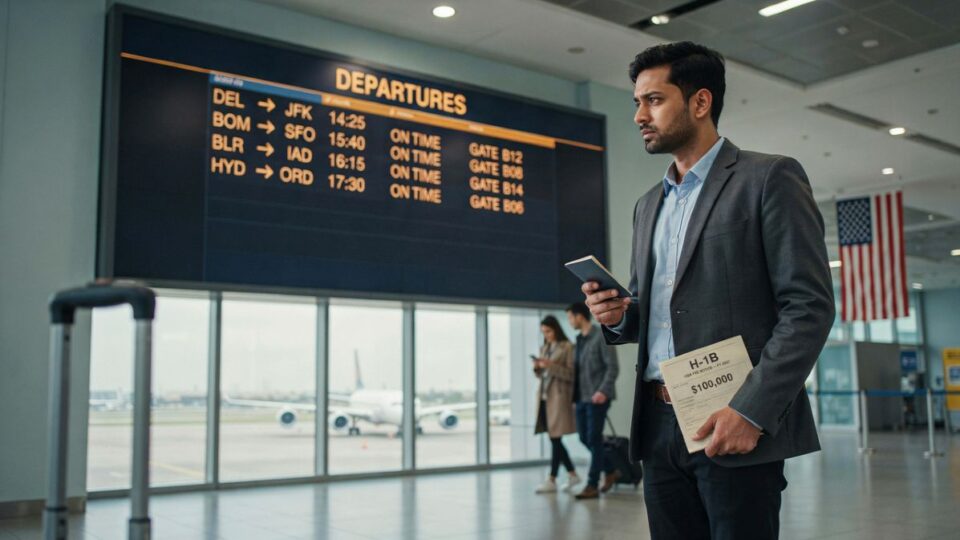
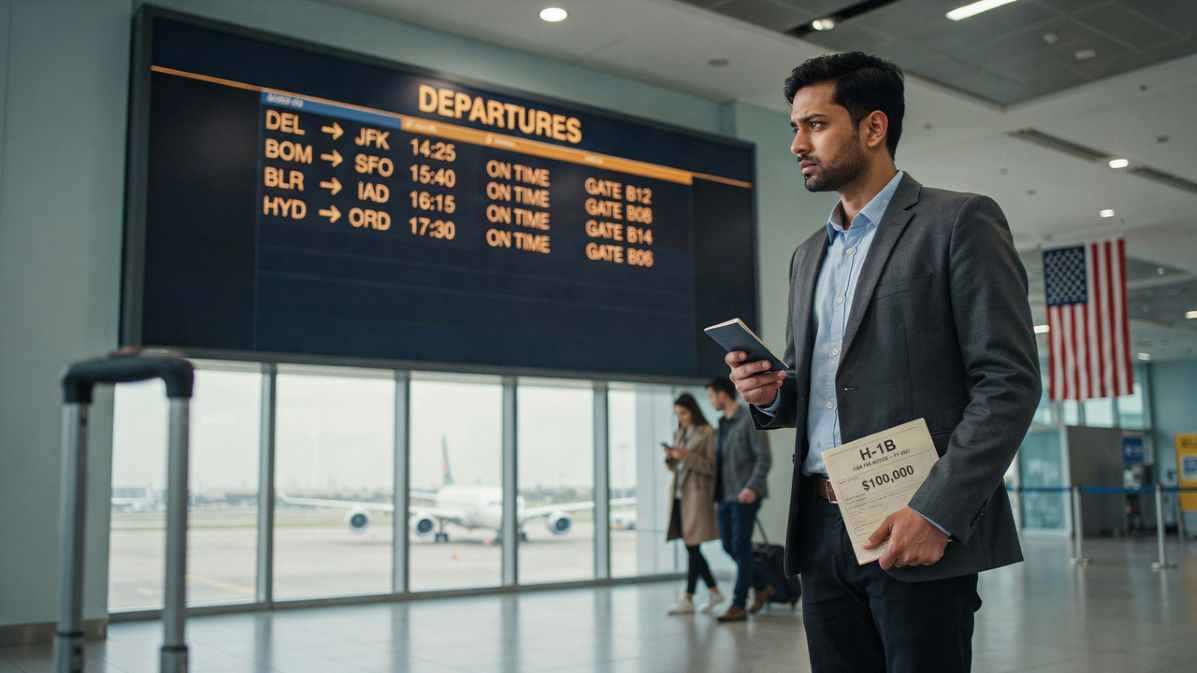
For Indian professionals planning a career move to the United States, the road to an American workplace has become more uncertain after President Donald Trump extended a controversial H-1B entry restriction for another year. The decision keeps a $100,000 employer payment requirement attached to certain H-1B workers seeking entry from outside the country, potentially affecting the way skilled employees travel, relocate and begin jobs in America.
H-1B Entry Restriction Extended Into 2027
The White House announced on September 18 that the restriction introduced in 2025 would continue for another 12 months. The renewed proclamation is scheduled to remain in effect until September 21, 2027, unless it is extended again.
The policy applies to certain H-1B specialty-occupation workers who are outside the United States and are seeking entry based on qualifying petitions. Under the proclamation, employers must make a $100,000 payment before filing an H-1B petition for an affected worker, subject to limited exceptions.
The measure is therefore more significant for international mobility than a conventional visa-price increase. For an overseas professional, the ability to travel to the United States for a new job can depend on whether the sponsoring employer meets the additional financial requirement.
India Remains Central to the H-1B Travel Story
India has a particularly important connection to the H-1B programme. U.S. Citizenship and Immigration Services data show that a substantial share of new H-1B employment involves workers who require consular processing or port-of-entry notification because they are outside the United States.
USCIS reported that almost 46% of approved petitions for initial employment in fiscal year 2024 requested consular or port-of-entry notification. That means international travel is an important part of the H-1B pipeline, particularly for workers beginning U.S. employment from abroad.
For Indian professionals, the consequences extend beyond the visa process itself. A successful H-1B application can involve an international relocation journey covering flights, accommodation, family movement and eventually repeated travel between India and the United States.
The Rule Does Not Mean Every H-1B Traveller Pays $100,000
One of the most important details for travellers is that the $100,000 amount is not a charge that an existing H-1B worker simply pays every time they fly into America.
The proclamation specifically targets certain H-1B workers outside the United States whose petitions fall within the scope of the restriction.
The State Department’s original guidance also stated that the 2025 proclamation did not automatically revoke existing H-1B visas. The restriction applied to visa issuance and entry based on qualifying petitions filed after the proclamation’s effective date.
For an Indian professional already legally working in the United States, travelling to India for a holiday or family visit is therefore a different situation from an overseas worker trying to obtain a new H-1B position and enter the country for the first time.
What the Extension Could Mean for India–US Travel
The most interesting travel consequence may not be a sudden decline in passenger numbers. Instead, the policy could gradually influence why people travel between India and the United States.
If American companies decide that bringing certain overseas workers into the country is too expensive, some employers could reconsider relocation plans. They may instead hire workers already in the United States, build teams in India or use other international locations.
That could change the nature of corporate travel.
Instead of an employee permanently relocating from Bengaluru or Hyderabad to California, for example, a company could keep the employee in India and send them to the United States periodically for meetings, training or project work.
This would represent a shift from migration-driven travel to business-driven travel.
New H-1B Applications Face Additional Scrutiny
The $100,000 requirement is not the only change announced by the Trump administration.
A separate executive order directs U.S. agencies to consider whether an employer has recently carried out, or plans to carry out, layoffs affecting similarly situated American workers when evaluating H-1B-related applications.
The order also calls for greater coordination between federal agencies and the use of information concerning wages, employment conditions, academic backgrounds and industry conditions.
For prospective international workers, this means the H-1B process is becoming more closely connected to the employer’s broader workforce practices.
Visa Screening Is Also Becoming More Extensive
The travel implications extend into the visa interview and screening process.
The U.S. State Department says H-1B applicants are already among the visa categories subject to expanded online-presence review. The department has also announced further expansion of online-presence screening to additional nonimmigrant visa categories from October 1.
For H-1B travellers, this adds another layer to an already detailed visa process. Applicants must continue to demonstrate eligibility and comply with the requirements associated with their visa category.
Legal Battle Keeps the Situation Uncertain
There is an important caveat surrounding the $100,000 requirement: its legal status remains contested.
The payment requirement has faced challenges in U.S. federal court, meaning the administration’s decision to extend the proclamation does not by itself settle the underlying legal dispute.
That distinction matters for travellers and employers. The White House has announced the extension, but implementation remains connected to the ongoing litigation and any subsequent court decisions.
What Indian Travellers Should Watch Next
For Indian professionals hoping to begin careers in America, the biggest issue is no longer simply how much a U.S. visa costs. The more important question is whether an employer is prepared and legally able to sponsor the worker under the rules applicable when the petition is filed.
For airlines and travel companies, meanwhile, the story is worth watching for a different reason. H-1B workers form part of a broader India–US mobility network involving business travel, family visits, relocation journeys and repeat international trips.
For someone sitting at an airport in Delhi or Bengaluru with a U.S. job waiting on the other side, immigration policy can feel surprisingly close to the travel experience itself. A rule written in Washington can ultimately influence whether that journey happens at all, how often it happens, and whether the traveller relocates permanently or continues crossing the Atlantic for work.
For now, the United States has kept the $100,000 H-1B restriction on the books for another year, making September 2027 the next major deadline to watch for Indian professionals, employers and the wider India–US travel market
The post United States Travel Rules Change as Trump Extends $100,000 H-1B Requirement Through 2027 appeared first on Travel And Tour World.
