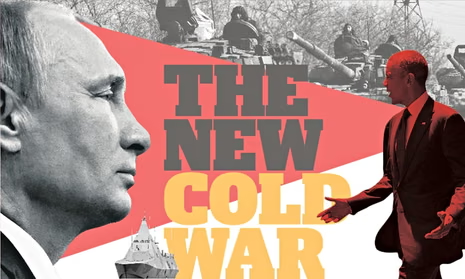
Is the world quietly entering a new Cold War? It’s a question global analysts are asking more urgently than ever. The signs are unmistakable: shifting alliances, technological battles, military posturing, and ideological divides that echo the tensions of the 20th century—but with far higher stakes.
Unlike the last Cold War, which shaped the world for decades, this new wave of rivalry is more complex, more interconnected, and far less predictable. Nations are not merely competing for military superiority—they are fighting for dominance in technology, trade, information, energy, and global influence. And as these silent battles intensify, the world finds itself standing at the edge of a new geopolitical era.
Here’s why analysts believe a “New Cold War” may already be unfolding—and what it means for the future.
1. A Multipolar World Replacing a U.S.-Led Order
For decades, the global order was shaped largely by American leadership. But that landscape is shifting rapidly.
China’s Rise as a Global Challenger
China has become a strategic competitor to the United States across multiple fronts:
- Military power with advanced missile systems and naval expansion
- Economic reach through the Belt and Road Initiative
- Technological leadership in 5G, AI, and surveillance tech
- Diplomatic influence in Africa, Asia, and the Middle East
Beijing’s ambitions extend far beyond regional dominance—its goal is global parity, if not supremacy.
Russia’s Quest for Strategic Influence
Despite economic pressure and isolation, Russia continues to assert itself through:
- Military involvement in Europe and Central Asia
- Energy pressure on Europe
- Cyber capabilities used for intelligence and disruption
- Strategic partnerships with China, Iran, and parts of the Global South
The Kremlin’s long-term strategy is clear: weaken Western alliances and reshape global balance.
A Growing “Non-Aligned” Bloc
Countries like India, Brazil, Saudi Arabia, Türkiye, and Indonesia are adopting strategic autonomy, refusing to side fully with any major bloc. This creates a fluid and unpredictable geopolitical environment—one where traditional alliances are no longer guaranteed.
The world is no longer bipolar or unipolar. It is multipolar—and that shift is heightening rivalries.
2. Technology: The New Battlefield of Dominance
If the last Cold War was defined by nuclear weapons, the new one is defined by technology supremacy.
AI, Quantum Computing & the Digital Arms Race
The race for artificial intelligence dominance is shaping global power. Nations understand that whoever controls AI will control:
- Military decision-making
- Cyber capabilities
- Global finance
- Data-driven governance
- Surveillance and intelligence systems
Quantum computing adds another layer of strategic tension—one breakthrough could render existing cybersecurity defenses obsolete.
Cyber Warfare: The Invisible Conflict
Cyberattacks have become the new language of conflict. Analysts estimate that major powers conduct or face:
- State-sponsored hacking
- Infrastructure penetration
- Data theft
- Election influence operations
- Digital sabotage
These attacks rarely make headlines, yet they form the backbone of new geopolitical rivalries—silent battles fought without crossing physical borders.
3. Military Posturing and Increasing Flashpoints
Though nations avoid direct war, military tensions are rising around some of the world’s most sensitive regions.
The Indo-Pacific: The World’s New Power Theater
The South China Sea, Taiwan Strait, and the broader Indo-Pacific have become the epicenter of great power competition.
- China expands its military presence
- The U.S. strengthens alliances with Japan, Australia, the Philippines
- India asserts influence through its navy
- Smaller nations are pulled into a great-power tug-of-war
A miscalculation here could spark global consequences.
Eastern Europe and the Arctic
Russia’s strategic moves in Eastern Europe—and increasing interest in the Arctic’s natural resources—are driving tensions with NATO, which is expanding cooperation and presence in response.
Middle East Realignments
The region is no longer merely a battleground—it is becoming a space where powers like China and Russia challenge decades of Western influence.
Overall, the world sees military buildups hidden beneath “routine exercises”—clear indicators of rising strategic competition.
4. Economic Warfare: Sanctions, Supply Chains & Trade Battles
Economic rivalry is becoming the new weapon of influence.
Sanctions as Tools of Power
Sanctions against Russia, Iran, and others highlight how economic pressure has replaced open conflict. But these measures also create long-term fractures in the global economic system, pushing nations to create alternate alliances.
The Supply Chain Cold War
COVID-19 revealed the fragility of global supply chains. Now, major powers are racing to secure:
- Semiconductors
- Energy routes
- Food security
- Rare earth minerals
- Manufacturing bases
Countries are increasingly reshoring production or aligning with trusted partners—a move that weakens global interdependence and strengthens geopolitical blocs.
The Dollar’s Dominance Under Challenge
A subtle but significant shift is underway:
BRICS nations and others are exploring alternatives to the U.S. dollar for trade settlements.
If this movement grows, it could reshape global finance for decades.
5. Information Warfare: Narratives Becoming Weapons
In the digital era, controlling the narrative is as powerful as controlling an army.
Disinformation as a Strategic Tool
Major nations now deploy information to:
- Shape public perception
- Influence elections
- Fuel social divisions
- Undermine rivals
- Promote their geopolitical objectives
From social media manipulation to state-run outlets pushing propaganda, the battle for influence is ongoing, silent, and very real.
Media, Tech Giants & Government Influence
Big tech platforms have become geopolitical actors themselves. Governments quietly partner with or pressure these companies to shape digital spaces in their favor.
The result?
A world where truth itself is contested territory.
6. Global Institutions Under Pressure
The last Cold War led to the creation of institutions like the UN, NATO, IMF, and World Bank. Today, those institutions face credibility challenges and strategic contest.
Why Institutions Are Weakening
- Major powers bypass global frameworks with bilateral deals
- Emerging nations demand more representation
- Trust in global bodies is fading
- Geopolitical competition paralyzes collective action
The weakening of global institutions makes conflict resolution harder—and geopolitical competition sharper.
7. A Cold War Without Borders
The original Cold War created two clear blocs. The New Cold War is far more complex—and far more dangerous.
Instead of a single ideological divide, we now see:
- Tech alliances
- Resource alliances
- Security alliances
- Regional blocs
- Economic partnerships
These overlapping interests create a web of competition, making any geopolitical shock capable of triggering widespread disruption.
And unlike the 20th-century Cold War, today’s rivalries unfold in real time, amplified by social media, global markets, and instantaneous information.
Conclusion: Are We Already in a New Cold War?
Analysts increasingly argue yes—but with a critical twist.
This Cold War is not defined by nuclear standoffs or clear-cut alliances. Instead, it’s a multidimensional struggle fought simultaneously across technology, economy, military power, resources, and digital influence.
Major nations may not openly admit it, but the world is drifting toward a new era of strategic confrontation—one that is quieter, sharper, and more complex than anything before.
The question is no longer if a New Cold War is emerging.
It is whether the global community can navigate this dangerous new rivalry without allowing history to repeat itself.
