
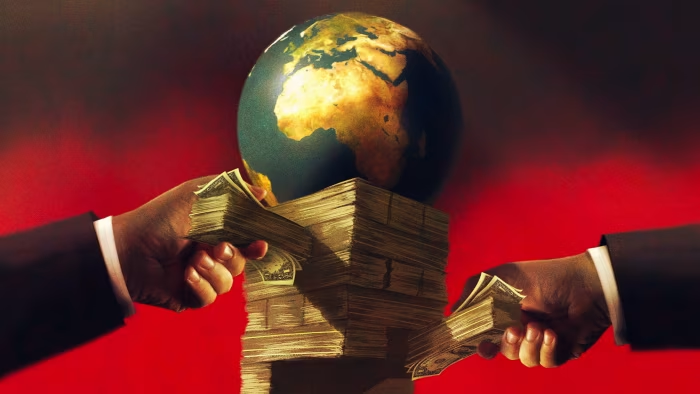
A quiet revolution is underway—one that could redefine the global economy for decades. Economists and policymakers warn that the world is no longer moving toward deeper integration but toward fragmentation, forming two powerful and competing economic blocs. This shift isn’t sudden; it has been accelerated by geopolitics, sanctions, supply chain disruptions, and the rising ambitions of emerging powers.
The question is no longer if the global economy is splitting—but who will shape the new financial order that follows.
Here’s an inside look at the forces driving this great divide, the players competing for dominance, and what the future global economy may look like.
1. Globalization Is No Longer Linear—It’s Breaking Into Fault Lines
For nearly three decades, globalization lifted economies, expanded trade, and tightened economic interdependence. But the assumption that economic integration is irreversible now seems outdated.
Several key events triggered the shift:
- U.S.–China trade tensions
- Global supply chain collapses post-pandemic
- Sanctions weaponized as tools of geopolitical influence
- Shifting energy alliances
- The rise of nationalized industries and protectionist policies
These forces have fractured the once-unified global economic system into two competing camps:
Bloc 1: The U.S.-led Western Financial System
Built on the dollar, Western banks, global institutions, and traditional trade routes.
Bloc 2: The Emerging Economies’ Financial Network
Driven by China, supported by Russia, BRICS nations, and several non-aligned countries seeking autonomy from the Western economic order.
The world’s economic map is being redrawn—and the fault lines are widening.
2. The Dollar’s Dominance Is Being Questioned Like Never Before
For decades, the U.S. dollar reigned supreme as the world’s reserve currency, underpinning global trade, commodities, and financial markets. But moves by BRICS countries to explore alternative settlement currencies have raised questions about the future.
Why Countries Are Moving Away From the Dollar
- Sanctions demonstrated how the U.S. can freeze or restrict dollar-based assets
- Nations want self-reliance in payments
- Oil and gas traders are experimenting with yuan settlements
- BRICS expansion widened the number of nations interested in dedollarization
While the dollar isn’t disappearing anytime soon, its uncontested dominance is under challenge.
If enough nations diversify, the financial order will inevitably shift.
3. China’s Bid for Economic Leadership
China is at the center of the rising alternative bloc—and its strategy is multilayered.
The Belt and Road Initiative (BRI)
With infrastructure projects in over 140 countries, China has built new trade corridors that bypass Western influence.
Yuan Internationalization
China is steadily increasing yuan usage in:
- Cross-border trade
- Oil and natural gas settlements
- Development loans
- Central bank reserves
Digital Yuan & Fintech Influence
Beijing is a front-runner in central bank digital currencies (CBDCs). The digital yuan could become a blueprint for global digital payments—outside Western financial systems.
China isn’t just challenging the financial order; it’s creating a parallel architecture that rivals Western institutions.
4. The BRICS Expansion: A New Power Bloc Emerges
BRICS has transformed from a loose economic alliance into a geopolitical force. The expanded group includes major economies and energy-rich nations.
Why BRICS Matters
- Represents over 45% of global population
- Controls a massive share of oil and gas reserves
- Expanding its development bank as an alternative to the World Bank
- Pushing for a unified payment system independent of SWIFT
BRICS’ goal isn’t to destroy the Western system—it’s to build leverage and autonomy. And as more nations express interest in joining, its influence grows stronger.
5. The West’s Response: Strengthening Old Alliances, Building New Ones
While emerging economies rise, the West is not standing still. The U.S. and its allies are reinforcing strategic partnerships:
The “Friendshoring” Strategy
Companies are shifting manufacturing away from geopolitical rivals and into friendly nations like:
- India
- Vietnam
- Mexico
- Eastern European states
Industrial Reshoring
The U.S. and the EU are investing heavily in:
- Semiconductor production
- Clean energy
- Defense manufacturing
- Strategic supply chains
Financial Security Alliances
Western nations are enhancing cooperation through:
- The G7
- NATO economic strategies
- EU energy partnerships
- Indo-Pacific alliances
The West aims to maintain dominance by tightening its core economic network.
6. Technology: The New Frontline in the Financial Divide
The battle for economic influence is increasingly fought through technology, not tariffs.
5G, AI & Semiconductors
These industries are so strategically important that governments have moved from regulators to active participants. Nations now compete to lead:
- Artificial intelligence
- Chip manufacturing
- Quantum computing
- Military technologies
- Space-based networks
Digital Currencies & Payment Systems
The financial order of the future may be shaped not by banks but by:
- Blockchain systems
- CBDCs
- Fintech platforms
- AI-driven finance
Nations that dominate these technologies could also dominate the next economic era.
7. Energy Wars: The Hidden Force Behind the Split
Energy is no longer just a commodity—it’s a geopolitical weapon.
OPEC+ Influence
Oil-producing nations are aligning more closely outside U.S. influence, reshaping global energy flows.
Green Transition Rivalries
The race for renewable energy technologies—solar, wind, EV batteries—has become a battleground for influence.
Critical Minerals Competition
Nations are fighting over rare earth elements used in chips, EVs, and advanced tech.
Whoever controls these resources will shape future industries.
Energy isn’t just powering cities; it’s powering strategic realignments.
8. A Divided Global Economy: What the Future May Look Like
If the split continues, the world may move toward:
Two Parallel Systems
- Two trade networks
- Two digital payment systems
- Two technological ecosystems
- Two competing financial institutions
Regionalization Over Globalization
Countries will prioritize nearby partners and “trusted” economies.
Economic Loyalty Tests
Nations may be forced to pick a side—especially in technology and finance.
Reduced Global Cooperation
From climate change to global health, coordination may become difficult as rival blocs distrust each other.
Conclusion: Who Will Lead the New Financial Order?
The answer is not straightforward.
The U.S. still has unmatched financial influence:
- Dollar dominance
- Deep capital markets
- Global institutions
- Military power
China leads the rise of an alternative system:
- Infrastructure diplomacy
- Rising global influence
- Technological progress
- BRICS partnerships
Other nations—India, the Middle East, Southeast Asia—are emerging kingmakers.
They hold the swing votes in a divided global economy.
They are not choosing sides—they are choosing opportunities.
Final Thought
The world is entering a new economic era—one defined not by cooperation, but by competition for influence.
A financial “Cold Split” is underway, and its outcome will shape the global balance of power for generations.
Who leads the new order will depend on who adapts fastest, innovates most, and builds the alliances that matter.
