
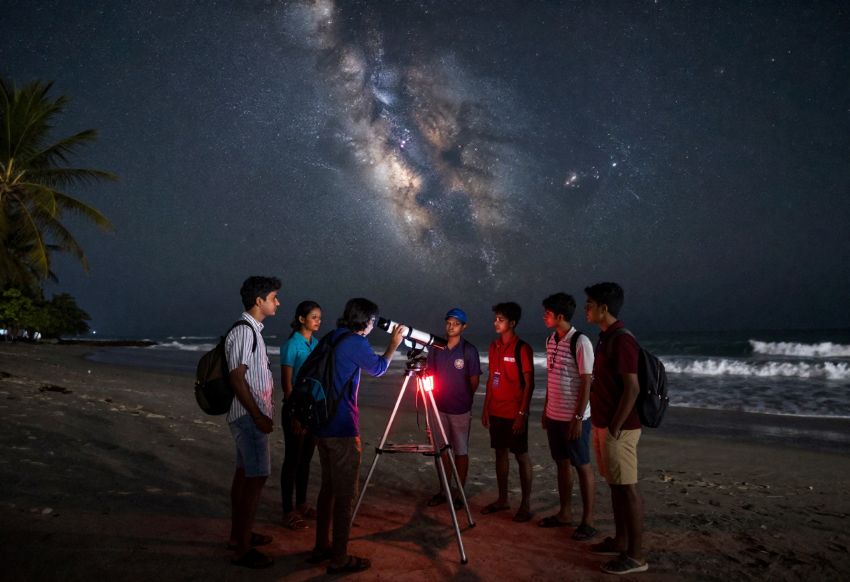
The Andaman Islands have long been popular among international visitors due to the pristine beaches and turquoise waters. The Andaman and Nicobar Administration’s Tourism Department is currently orchestrating a significant shift towards experience-based travel. It has been announced that a specialised skill development training programme for Astro Guides will begin in March, signalling a departure from the traditional sun-and-sand itinerary. This initiative aims to capitalise on the islands’ unique geographic advantage—minimal light pollution—to establish a niche market for stargazing and celestial photography.
By focusing on Mayabunder and Little Andaman, the administration is deliberately decentralising tourism, pushing the boundaries of exploration beyond the well-trodden paths of Havelock and Port Blair. The inclusion of the night sky in the local tourism portfolio is viewed as a strategic move to provide travellers with a more profound, contemplative connection to the natural world.
Structured Learning in the Heart of the Islands
The logistics of this ambitious educational drive have been meticulously outlined by the authorities. It has been scheduled that the inaugural training session will be hosted in Mayabunder from March 5 to 7, 2026. This will be followed immediately by a secondary workshop conducted in Little Andaman between March 10 and 12, 2026. These locations have been chosen specifically for their expansive horizons and dark-sky potential, providing the perfect “open-air classroom” for aspiring guides.
The curriculum is expected to be a rigorous blend of academic theory and hands-on technical training. Participants will be immersed in the fundamentals of basic astronomy, including the identification of constellations, planets, and deep-sky objects. Furthermore, a heavy emphasis is being placed on the mechanical mastery of telescope handling. It is believed that by empowering local residents with these technical skills, a new layer of professional storytelling can be added to the island experience, where the myths of the stars are woven into the ecological history of the land.
Empowering the Local Youth and Economy
A primary objective of this programme is the creation of alternative livelihood opportunities for the island’s younger demographic. Eligibility for the training has been restricted to local youth and tourism stakeholders who are under the age of 40 and have completed at least a Class 12 education. This demographic focus is intended to ensure that the economic benefits of niche tourism are retained within the local community.
The transformation of local enthusiasts into certified Astro Guides is expected to catalyze a micro-economy centred around nighttime excursions. Rather than relying solely on daytime boat trips or snorkelling, tourism service providers will now be equipped to offer “midnight celestial safaris”. This diversification not only extends the average length of stay for visitors but also provides a stable, skill-based income stream for the youth who might otherwise seek employment outside the islands.
Sustainability and Responsible Night-Sky Observation
In an era where “overtourism” is a global concern, the Andaman Administration is prioritizing a sustainable framework. Within the training modules, a significant portion of time is being dedicated to responsible astro-tourism practices. Participants are being sensitized to the environmental sensitivities of night-time activities, ensuring that the introduction of artificial light or increased footfall in remote areas does not disrupt local nocturnal ecosystems.
The principles of visitor management and interpretation ethics are also being integrated into the syllabus. It is vital that the growth of this niche segment does not come at the cost of the islands’ ecological integrity. By training guides to act as stewards of both the land and the sky, the department is ensuring that tourism growth and conservation priorities are balanced with precision.
The Application Process and Future Outlook
For those eager to join this celestial movement, the window for application is narrow. It has been directed that all interested candidates must submit their documentation to the Planning Section of the Directorate of Tourism by 3 pm on March 2. To facilitate ease of access, application forms have been made available on the official government web portals, and an online submission link has been provided to accommodate those in more remote clusters of the archipelago.
The successful implementation of the Astro Guide programme is viewed as a pilot for broader capacity-building initiatives. It has been hinted by officials that if this model proves successful, similar training could be introduced for other emerging segments such as birdwatching, mangrove kayaking, and heritage walks. The long-term vision is clear: the Andaman and Nicobar Islands are being repositioned not just as a destination to see, but as a destination to learn and experience.
A Stellar Future for Island Travel
As the world becomes more urbanised and “sky glow” obscures the stars for billions, the importance of a truly dark sky cannot be overstated. By investing in the professionalisation of astro-tourism, the Andaman and Nicobar Administration is positioning the islands as a top destination for “astrophile” travellers. The night sky is poised to become the most enchanting new attraction on the islands thanks to a combination of community empowerment, technical education, and environmental stewardship.
The post Beyond the Blue: How the Andaman Islands are Pioneering Astro-Tourism for the Modern Voyager appeared first on Travel And Tour World.
