
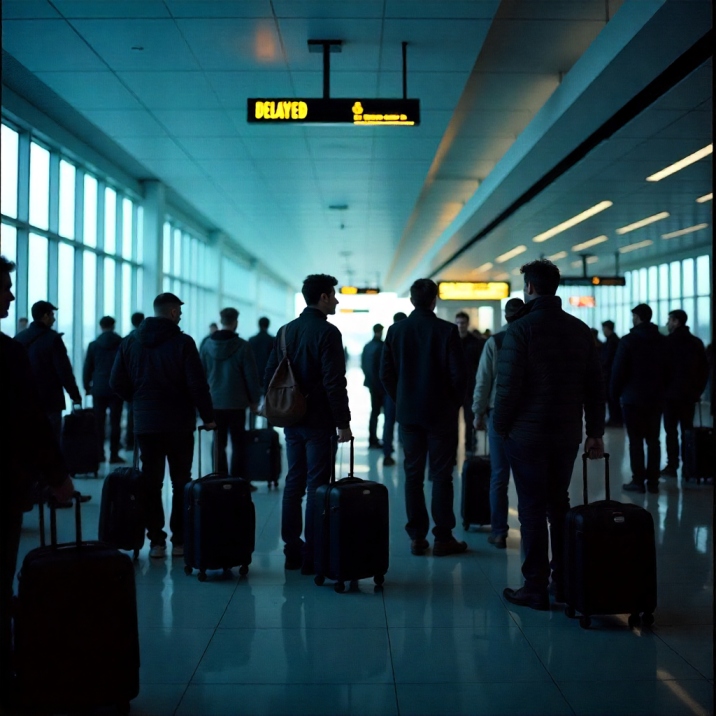
Travelers across France are facing a difficult day as significant flight disruptions ripple through the nation’s largest aviation hubs. Major scheduling issues have surfaced in Paris, Nice and Toulouse, leaving hundreds of passengers searching for answers. Air France currently sits at the center of this operational struggle, recording the highest number of grounded flights and extended wait times. In the capital, both major airports in Paris report a surge in stalled departures. Meanwhile, the coastal city of Nice and the southern hub of Toulouse are experiencing similar challenges. These 285 delays and 47 cancellations impact both domestic routes and international connections. Many passengers now face long queues and uncertain itineraries as carriers work to resolve the backlog. This report examines the data behind the current travel chaos. We break down the specific numbers for each airport and identify the primary airlines affected. Understanding these details helps travelers navigate the ongoing situation across the country’s busiest runways.
Major Airports Affected
The scale of the disruption has been concentrated in the country’s most vital transit hubs. In Paris, the impact is twofold, affecting both major international gateways. At Paris Charles de Gaulle/Roissy (CDG), the nation’s largest hub, a staggering 14 cancellations and 165 delays have been documented. This high volume of schedule displacement has led to significant congestion within the terminals. Meanwhile, the secondary hub of the capital, Paris Orly, has seen 17 cancellations and 64 delays, further complicating travel plans for those on domestic and European routes.
Moving toward the Mediterranean coast, the situation at the airport in Nice has mirrored the chaos seen in the north. Nice Cote d’Azur reported 9 cancellations and 23 delays, grounding a significant portion of the day’s scheduled traffic. Similarly, in the industrial and aerospace heartland of Toulouse, Toulouse-Blagnac Airport was not spared. It was reported that 7 cancellations and 33 delays occurred at this location, hindering the movement of both professional and leisure travelers.
Impacted Airlines
The airline most severely hit by these operational challenges is Air France. The carrier accounts for the vast majority of the documented disruptions across all four major sites. At Paris Orly, Air France recorded 17 cancellations and 15 delays. This trend continued at Charles de Gaulle, where the airline faced 13 cancellations and 88 delays. In the southern regions, the airline was responsible for 9 cancellations and 10 delays in Nice, as well as 7 cancellations and 12 delays in Toulouse.
While the national carrier sits at the center of the crisis, United Airlines reported 1 cancellation and 2 delays at Charles de Gaulle, indicating that the turmoil has extended beyond domestic and continental operations to affect transatlantic travel as well.
Beyond these specific figures, delays were being experienced by several other Airlines, like Air Algerie, Royal Air Maroc, Transavia France, Vueling Airlines, easyJet, Qatar Airways, Ryanair and more.
Probable Impact on Local Tourism
The economic consequences of such widespread aviation disruptions are expected to be felt across the hospitality and retail sectors of the affected regions. In Paris, where international tourism is a cornerstone of the economy, the delay of over 200 flights means a significant number of visitors may reach their accommodations late or be forced to shorten their stay, leading to potential revenue losses for local businesses.
In Nice, the grounding of flights could disrupt the steady flow of travelers to the French Riviera, a region heavily dependent on tourism. Likewise, in Toulouse, known for its cultural landmarks and historical architecture, the interruption of 40 flights total interferes with the city’s accessibility. When transit is interrupted at this scale across France, the “abandoned” status of many travelers often results in a decreased spending capacity and places a general strain on city infrastructure as passengers scramble to find last-minute local lodging.
What Affected Passengers Can Do Now
For those currently caught in the travel chaos, there are several steps that can be taken to mitigate the impact of the delays and cancellations. Travelers are advised to monitor their flight status through official airline mobile apps or websites before heading to the airport.
- Rerouting and Refunds: Under standard aviation protocols in France, passengers whose flights are canceled are typically entitled to a choice between rerouting to their final destination at the earliest opportunity or receiving a full refund for the unused portion of their ticket.
- Right to Care: If a delay exceeds a certain threshold—usually two hours or more depending on the flight distance—airlines are expected to provide “care and assistance.” This often includes vouchers for meals and refreshments, as well as two telephone calls or emails.
- Accommodation: In instances where a cancellation or long delay necessitates an overnight stay, carriers are generally required to provide hotel accommodation and transportation between the airport and the place of stay.
- Documentation: Passengers are encouraged to keep all receipts for out-of-pocket expenses incurred due to the disruption, as these may be necessary for future reimbursement claims.
The aviation network across France continues to work toward a return to regular operational rhythms. Until the backlog of flights is cleared, travelers in Paris, Nice and Toulouse are urged to remain patient and stay informed through official channels.
-The information provided is sourced from FlightAware.
The post France amid Travel Chaos as Airports of Paris, Nice and Toulouse Face 47 Flight Cancellations and 285 Delays, Affecting Carriers like Air France, United Airlines and others, New Update appeared first on Travel And Tour World.
