

For centuries, the Palatine Hill has stood as the “Beverly Hills” of ancient Rome—a verdant plateau where emperors built sprawling palaces atop the ruins of the republic. But beneath the red-brick skeletons of the Palatine lies a secret even older and more intimate than the houses of Augustus or Livia.
In a pioneering blend of archaeology and modern technology, Italy has officially opened the House of the Griffins to the public for the first time. The twist? You won’t actually step foot inside. To protect its 2,000-year-old frescoes, visitors will explore this subterranean marvel via high-definition livestreamed tours.
A Hidden Gem Under the Emperor’s Feet
The House of the Griffins is a rare Republican-era domus (house) dating back to the late 2nd or early 1st century B.C. While the Palatine is famous for the opulence of the Empire, this home represents a period when Rome was still a republic.
So why was it hidden? In the 1st century A.D., Emperor Domitian decided to build his massive imperial palace directly on top of it. Rather than destroying the house, workers filled the rooms with earth to create a solid foundation for the new palace above. This accidental “time capsule” preserved the House of the Griffins in extraordinary detail until it was rediscovered by archaeologists in the early 20th century.
The Livestream Experience: Safety Meets Storytelling
The decision to use livestreaming isn’t just a tech gimmick; it’s a vital conservation effort. The house is located deep underground and is accessible only by a “perilously steep” staircase that is unsafe for large groups. Furthermore, the presence of human breath increases humidity and carbon dioxide, which causes the delicate frescoes to flake and fade.
How the tour works:
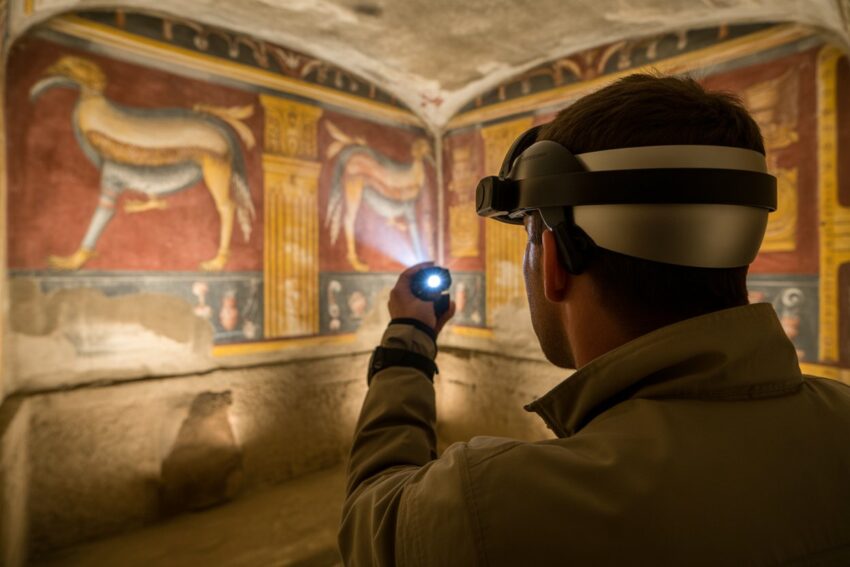
- The “Avatar” Guide: A trained guide from the Colosseum Archaeological Park wears a head-mounted smartphone or “smart glasses.”
- Real-Time Interaction: As the guide descends into the narrow, frescoed chambers, visitors remain in a climate-controlled room above ground or join remotely. They see exactly what the guide sees in high definition.
- The Narrative: The livestream allows for a real-time Q&A, making the experience feel like a conversation rather than a static video.
The Star of the Show: The Griffin Frescoes
The home is named after its most stunning feature: an arched lunette fresco depicting two griffins—the mythological half-eagle, half-lion creatures. These frescoes are among the best-preserved examples of “Second Style” Roman painting, characterized by an attempt to create three-dimensional depth on a flat wall.
Visitors will see:
- Fictive Architecture: Walls painted to look like they have marble columns and deep recesses.
- Vibrant Pigments: Deep reds and ochres that have retained their brilliance thanks to the darkness of the underground location.
- Intricate Mosaics: Floor patterns that showcase the craftsmanship of Rome’s early elite.
Bridging the Gap Between Eras
Project chief Federica Rinaldi notes that this initiative is part of a broader effort to make “invisible Rome” visible. The Palatine Hill is a layered “lasagna” of history. By using digital tools, the park can show visitors the Republican layer beneath the Imperial ruins without risking the structural integrity of the site.
The tours are scheduled to begin on March 3, 2026, held weekly on Tuesdays. Reservations are mandatory, and groups are strictly limited to a dozen people per session to ensure an intimate and informative atmosphere.
Why This Matters for the Future of Travel
The House of the Gryphons pilot program sets a new standard for sustainable tourism. It proves that we don’t have to choose between protecting our heritage and sharing it with the world. For the modern traveller, it offers a rare, “behind-the-scenes” look at a site that has been off-limits to everyone but specialised researchers for over a hundred years.
The post Italy Opens Ancient House of the Griffins via Livestream Tours appeared first on Travel And Tour World.
