

Kumukh Old Quarter, Dagestan: A Living Center of Lak Architecture and Culture
Introduction to the Historic Heart of Dagestan
Kumukh Old Quarter stands as one of Dagestan’s most culturally significant historic areas, preserving the architectural and social traditions of the Lak people. Unlike abandoned or partially ruined settlements, Kumukh remains alive, with its old quarter continuing to function as a center of daily life, memory, and identity. The area offers travelers a rare opportunity to experience an authentic historical environment that has evolved without losing its original structure.
For cultural travelers, heritage explorers, and those interested in indigenous architecture, Kumukh Old Quarter represents a deeply meaningful destination where history is lived rather than displayed.
Location and Geographic Setting of Kumukh
Positioned in the Mountainous Heart of Dagestan
Kumukh is located in central Dagestan, surrounded by rolling hills and mountain ridges that shape both climate and settlement patterns. Its position made it historically important as a cultural and administrative center.
Geography shaped influence.
Natural Landscape Supporting Settlement Growth
The surrounding terrain provided protection, resources, and trade routes, allowing Kumukh to develop into a stable and enduring community.
Land supported continuity.
Historical Importance of Kumukh Old Quarter
A Center of Lak Political and Cultural Life
Kumukh historically served as a major center for the Lak people, playing an important role in governance, education, and cultural development. The old quarter reflects this prominence through its layout and construction.
History shaped structure.
Continuity Across Centuries
Rather than undergoing complete reconstruction, the old quarter evolved gradually, preserving its original street patterns and building techniques.
Time respected form.
Traditional Lak Architecture in Kumukh
Stone Construction and Compact Design
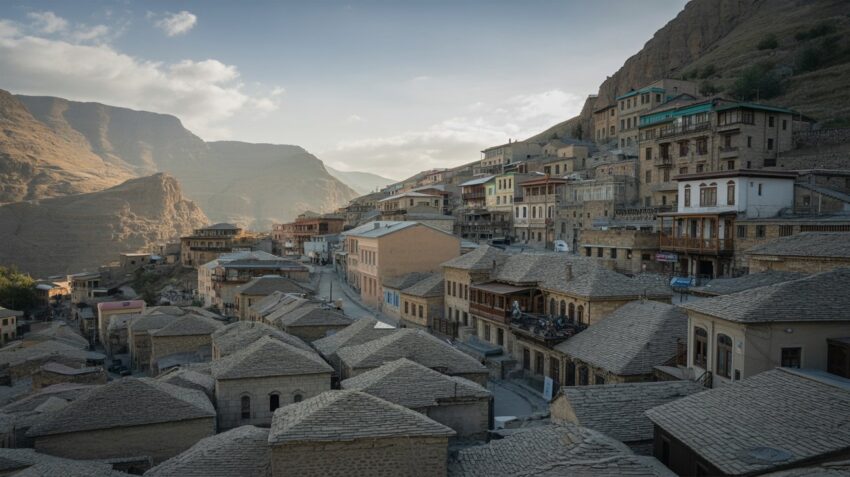
Homes in Kumukh Old Quarter are built primarily from stone, arranged closely together to conserve space and provide insulation. This compact design reflects both environmental adaptation and social cohesion.
Architecture reflects community.
Multi-Level Homes and Terraced Layouts
Buildings often rise several levels, following the slope of the land. Rooftops, terraces, and stairways create a layered urban fabric unique to Lak settlements.
Vertical design defines identity.
Urban Layout of the Old Quarter
Narrow Lanes and Interconnected Paths
The old quarter features narrow passageways designed for foot travel. These paths connect homes, courtyards, and communal areas, encouraging interaction.
Movement builds connection.
Community-Oriented Spatial Planning
The layout emphasizes shared spaces and visibility, reinforcing strong social bonds and collective responsibility.
Design supports society.
Visual Atmosphere of Kumukh Old Quarter
Stone, Light, and Shadow
Sunlight filters through narrow lanes, creating dynamic patterns of light and shadow on stone walls. This changing atmosphere adds depth to the experience of walking through the quarter.
Light animates history.
A Harmonious Blend With the Landscape
Stone buildings mirror the tones of the surrounding hills, allowing the settlement to blend naturally into its environment.
Harmony enhances endurance.
Tourism Value of Kumukh Old Quarter
Cultural and Educational Tourism
Kumukh Old Quarter offers insight into Lak traditions, architecture, and community organization. Travelers gain understanding through observation rather than interpretation panels.
Experience becomes education.
Authentic Heritage Travel
Unlike reconstructed heritage sites, Kumukh provides an unfiltered view of living tradition, making it especially valuable for responsible cultural tourism.
Authenticity builds trust.
Exploring Kumukh Old Quarter
Walking Through Historic Lanes
Exploration is best done on foot, allowing visitors to appreciate details such as stonework, doorways, and spatial relationships.
Walking reveals layers.
Observing Daily Life
Daily routines unfold naturally within the old quarter, offering visitors insight into how tradition and modern life coexist.
Life sustains heritage.
Relationship Between Architecture and Culture
Buildings as Cultural Expression
Lak values of cooperation, resilience, and continuity are embedded in architectural choices and settlement layout.
Culture becomes structure.
Adaptation Without Loss
While modern amenities exist, they are integrated carefully, allowing the old quarter to maintain its historic character.
Adaptation preserves identity.
Photography and Visual Documentation
Capturing Living Heritage
Photographers are drawn to textures, patterns, and human-scaled spaces rather than grand monuments.
Detail tells the story.
Ethical Photography Practices
Respectful photography avoids intrusion into private spaces and focuses on atmosphere rather than individuals.
Respect ensures welcome.
Responsible Tourism in Kumukh
Respect for Residents
Visitors should remember that Kumukh Old Quarter is a living neighborhood. Quiet observation and respectful behavior are essential.
Courtesy sustains harmony.
Supporting Preservation Through Awareness
Understanding the significance of the old quarter helps ensure that tourism contributes positively rather than disruptively.
Awareness protects heritage.
Best Time to Visit Kumukh Old Quarter
Seasonal Accessibility
Late spring through early autumn offers comfortable temperatures and easier travel conditions. Winter brings challenges but adds atmospheric beauty.
Season shapes experience.
Optimal Times of Day
Morning and late afternoon provide softer light and calmer conditions for walking and observation.
Timing enhances immersion.
Accessibility and Travel Planning
Road Connections
Kumukh is accessible by regional roads connecting it to other parts of Dagestan, making it suitable for cultural itineraries.
Connectivity supports visitation.
Preparing for On-Foot Exploration
Comfortable footwear and a slow pace are essential due to stone paths and elevation changes.
Preparation ensures enjoyment.
Educational Value for Visitors
Learning Indigenous Urban Design
Kumukh Old Quarter demonstrates how indigenous communities developed efficient, sustainable urban forms.
Tradition informs innovation.
Understanding Cultural Continuity
The area illustrates how identity is maintained through everyday use of space rather than preservation alone.
Use sustains memory.
Kumukh Old Quarter in Dagestan Tourism
A Cornerstone of Cultural Routes
Kumukh complements natural attractions by providing cultural depth and historical context.
Culture balances nature.
Encouraging Sustainable Cultural Travel
Low-impact visits focused on learning align with long-term preservation goals.
Sustainability ensures longevity.
Safety and Visitor Awareness
Navigating Narrow Lanes
Careful movement is required along stone paths and stairways.
Attention prevents accidents.
Weather Considerations
Mountain weather can change quickly, making preparation important.
Readiness supports safety.
The Enduring Heart of Lak Heritage
Kumukh Old Quarter remains a powerful example of how architecture, culture, and community can endure together across centuries. Its stone lanes, compact homes, and layered layout tell a story of adaptation without erasure, offering travelers a rare chance to witness living heritage.
For those seeking meaningful cultural tourism in Dagestan, Kumukh Old Quarter provides depth, authenticity, and insight. It is not a destination to rush through, but a place to walk slowly, observe, and understand how history continues to shape daily life in the mountains of the Caucasus.
The post Kumukh Old Quarter Tourism: Exploring Traditional Lak Architecture in Dagestan appeared first on Travel And Tour World.
