
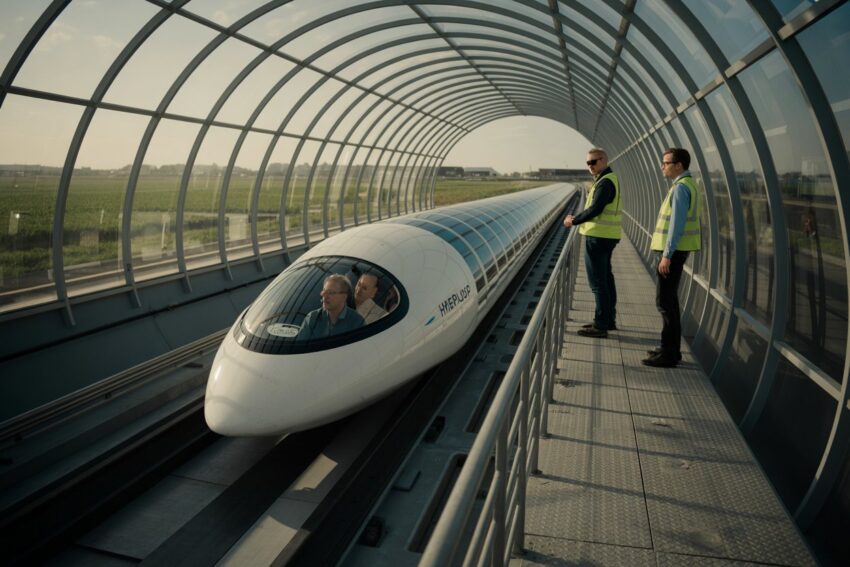

I still remember the first time I rode the Eurostar — the thrill of watching countryside blur into city, the small, private triumph of being in Paris by dinner. Now, engineers in the Netherlands are testing hardware that promises to shrink that same journey to a sliver of time. The work taking place at the continent’s new test hub could one day make London–Paris in twenty minutes more than a headline — but only if a string of technical, political and regulatory puzzles are solved.
Short version: what’s happening
Europe’s hyperloop effort — led by a coalition of companies and research groups using a 420-metre test tube in Veendam — has moved from drawings to demonstrators: levitated pods, magnetic guidance trials and a lane-switch mechanism meant to let pods change tracks without stopping. The test center has already hosted a series of short runs and a lane-switch demonstration that project backers call a vital step toward scalable networks.
The reality behind the “20-minute” number
On paper the claim is straightforward arithmetic. The straight-line distance between London and Paris is roughly 344 km; to reach it in about 20 minutes requires cruise speeds in the order of 1,000 km/h or more — easily within the theoretical envelope that vacuum-tube concepts aspire to. But the leap from theoretical speed to a safe, certified, cross-border passenger service is enormous: test-tube speeds are small, continuous vacuum control, routing and emergency protocols are not yet solved at operational scale, and building a protected right-of-way across heavily used land and a busy channel poses massive practical problems.
Who’s running tests and who’s funding them
The European Hyperloop Center — a collaboration hub and testbed in Groningen province — hosts developers and serves as the focal hardware site. Companies such as Hardt Hyperloop have run vehicles and demonstrated lane switching; public funding and EU innovation programmes have been contributors to the effort. National and provincial funds, European innovation grants, and private investors all back the research push.
Governments are watching — cautiously
National transport authorities are taking measured interest. The UK’s technical advisory bodies have previously examined hyperloop technology and flagged the gap between laboratory promise and regulatory readiness; local transport agencies state they are monitoring developments but have no immediate rollout plans. Meanwhile, Brussels has taken steps to commission fact-finding studies to assess how member states and regulators might approach the technology. Those signals show political curiosity, but not yet the green light for a cross-channel build.
The technical mountain still to climb
Engineers face four interlocking technical problems:
- Vacuum maintenance at scale. Keeping a low-pressure environment across dozens or hundreds of kilometres — with joints, expansion gaps and maintenance access — is orders of magnitude harder than a 420-metre tube.
Safety and evacuation. Long, enclosed tubes create new emergency scenarios (power loss, decomposition of a pod, medical emergencies) that regulators have not yet standardised.
Thermal, structural and materials stresses. Continuous tubes must manage temperature swings, ground movement and interface with existing infrastructure.
Cost and planning. Land acquisition, tunnelling or raised structures, and cross-border agreement on standards will push price tags into the multi-billion euro range. Historical megaproject experience suggests this is rarely linear in time or budget.
The sector’s credibility: progress and past pitfalls
Hyperloop rhetoric has a long hype cycle. Several early ventures stalled or pivoted, but the European approach — public-private test infrastructure, shared labs and staged validation — represents a more conservative and methodical path. A key success for believers is that independent test facilities allow different teams to validate components under controlled conditions, rather than depending on a single firm’s roadmap. Yet sceptics point to decades of impressive prototypes that never reached scale.
When — realistically — could this hit the map?
Optimistic timelines put pilot passenger corridors in the 2030s. Realists and many independent analysts warn that routine passenger service across international borders (with full certification and viable economics) is a multi-decade conversation. The timetable depends less on a single engineering miracle than on sustained funding, harmonised regulation and political will in multiple jurisdictions.
What passengers might actually experience
If networks materialise, the ride could feel closer to an aircraft cabin on rails: quick acceleration to very high speed, low external noise, and a travel time significantly shorter than trains or short flights for certain corridors. But passengers may also face unfamiliar screening and station procedures, novel safety briefings and—for some—discomfort from high sustained speeds. Transit planners will need to design terminals, transfers and last-mile connections to capture the real time savings as usable door-to-door reductions.
Bottom line
For many of us who travel between London and Paris with some frequency, the idea of cutting that trip to the length of a short film is intoxicating. The current experiments in the Netherlands are real and important — they move the field forward from sketches to hardware — but they are not a timetable. The path from 420-metre tube to cross-Channel service is long, expensive and full of policy negotiations. Until those pieces come together, the dream remains a compelling possibility rather than an imminent reality.
The post London, Paris Inside the Dutch Test Tube That Promises 20-Minute Cross-Channel Travel — Why Technical Breakthroughs and Regulatory Battles Mean It’s Still a Long Road appeared first on Travel And Tour World.
