
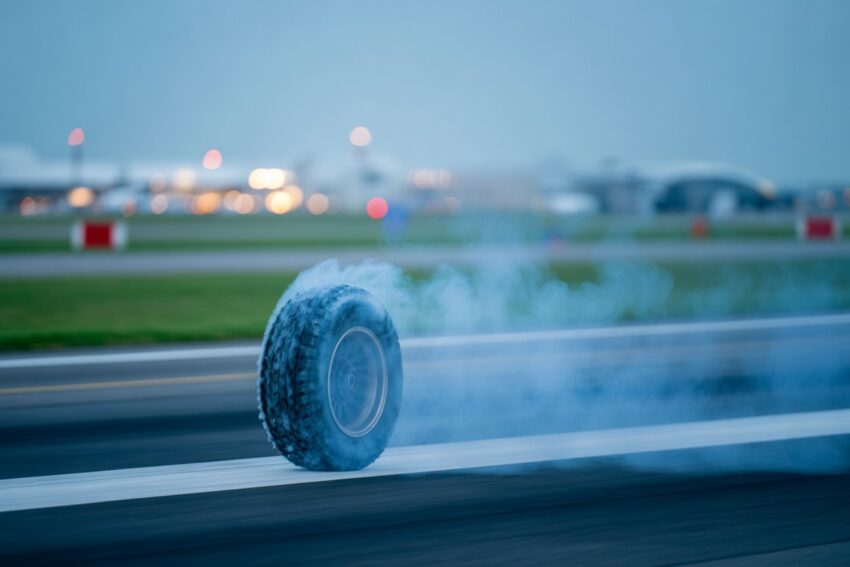

When we think about airport pollution, the mind immediately jumps to the roar of jet engines and the pungent smell of burning fuel. For decades, the conversation around aviation’s environmental footprint has been dominated by carbon dioxide and nitrogen oxides spewing from exhaust pipes. But new research published in the journal Environmental Chemistry and Ecotoxicology suggests we have been ignoring a massive, “acutely toxic” piece of the puzzle: the tires.
Scientists recently conducted a first-of-its-kind study at the Milan Linate Airport in Italy, looking specifically for a class of chemicals called benzothiazoles (BTH). What they found was startling. The very act of landing and taking off—processes that rely on high-friction contact between rubber and pavement—is releasing hazardous organic compounds into the air at levels comparable to the most traffic-congested cities in the world.
What is Benzothiazole (BTH)?
While these chemicals make our modern life possible, they aren’t exactly friendly neighbors. Researchers describe BTH components as “irritant, corrosive, and acutely toxic to living organisms.” Historically, BTH has been used as a “marker” for road traffic pollution because it is so prevalent in car tires. However, this study provides the first definitive evidence that airports are also significant local hotspots for these chemicals.
Tire Wear Particles: The Non-Exhaust Hazard
Most of us assume that if a vehicle doesn’t have an exhaust pipe, it isn’t polluting. This is a myth. Every time an airplane lands, those “puffs” of blue smoke you see as the wheels hit the tarmac aren’t just for show. They are the result of Tire Wear Particles (TWPs)—tiny fragments of rubber and chemical additives being shredded off the tire and into the atmosphere.
The scale of this “hidden” pollution is massive. To put it in perspective:
- Frankfurt Airport alone was estimated to release roughly 83 tons of tire wear particles in a single year (2019).
- These particles are often smaller than 10 micrometers (PM10), meaning they are small enough to be inhaled deep into human lungs.
- Unlike jet fuel, which burns up, these chemical-heavy rubber particles linger in the soil, water, and air around the airport.
The Findings at Milan Linate
The research team, led by Professor Andrea Gambaro, analyzed the air at Milan Linate and discovered that the concentration of eight different types of BTH was significantly higher near the airport than in other urban areas.
Interestingly, the study found that BTH levels didn’t necessarily spike only during flights. Instead, they correlated with general airport activity—including the movement of ground support vehicles, baggage handlers, and de-icing procedures. This suggests that an airport is a 24/7 “pollution factory” that continues to emit toxins even when planes aren’t in the sky.
Why This Matters for Public Health
For the millions of people who live within a 10-mile radius of major airports, this research adds a new layer of concern. We already know that long-term exposure to aviation-related particulate matter is linked to:
- Respiratory conditions like asthma and decreased lung function.
- Cardiovascular issues, including high blood pressure and increased stroke risk.
- Emerging links to cognitive decline and dementia.
While the study noted that the immediate “occupational risk” for airport workers remains relatively low under current safety standards, the cumulative environmental impact is a “critical gap” in our understanding of air safety.
Humanizing the Transition: Toward a Greener Tarmac
It is easy to feel overwhelmed by the “toxic” nature of these findings, but the goal of the scientific community isn’t to ground all flights. Rather, it is to provide the data necessary to innovate. If we know that tire wear is a primary source of BTH, we can look toward:
- New Materials Science: Developing tire compounds that use less hazardous vulcanization accelerators.
- Better Ground Tech: Electrifying ground support equipment to reduce the “secondary” sources of BTH.
- Sustainable Infrastructure: Improving runway surfaces to minimize friction-related wear without sacrificing safety.
Aviation connects the world, but as this study shows, that connection shouldn’t come at the cost of the health of the communities on the ground. By shining a light on “non-exhaust” pollutants like benzothiazole, we are finally seeing the full picture of what it takes to fly.
The post New Study Reveals ‘Acutely Toxic’ Benzothiazole Pollution at Airports: The Hidden Impact of Tire Wear Particles appeared first on Travel And Tour World.
