
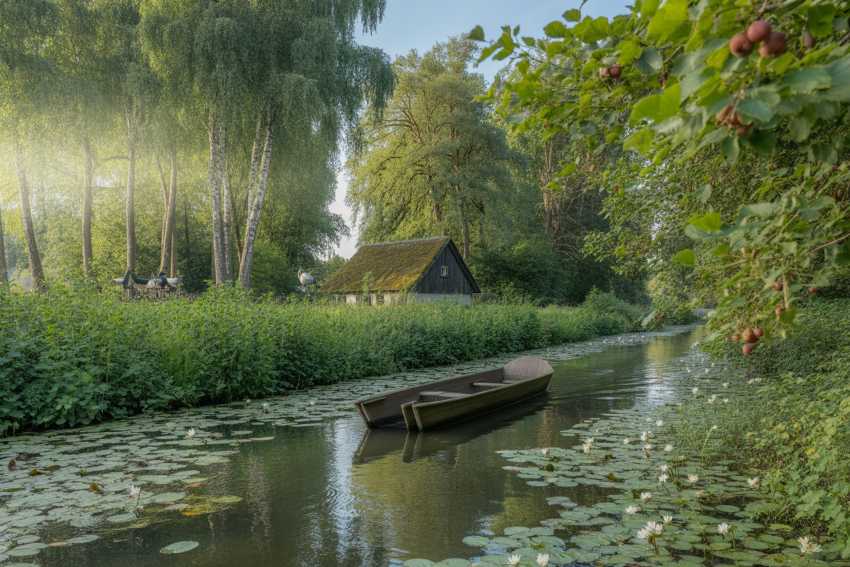
Brandenburg’s heart contains a serene network of emerald-green waterways, dense woodlands, and sprawling meadows. This region, known as the Spreewald, is increasingly recognised not only as a historical relic of German geography but also as a sophisticated blueprint for the future of sustainable tourism. A deliberate balance is struck between preserving ancient landscapes and implementing forward-thinking ecological strategies. It is a destination where nature is not only protected from human intervention but also actively improved through thoughtful, integrated management.
Within this UNESCO biosphere reserve, a distinct philosophy of “co-existence” is promoted. Rather than the traditional conservation model of strict non-interference, a collaboration between the land and its inhabitants is fostered. This ensures that the delicate ecosystem, which spans 186 miles of navigable canals, continues to be a sanctuary for biodiversity while also providing a functional home for the local community.
The Engineering of a Watery Wilderness
The intricate landscape observed by modern travellers was not formed by nature alone. Hundreds of years ago, this flat river valley existed as a wild, inaccessible swampland. To ensure survival and the possibility of agriculture, the land was transformed by early settlers through the installation of extensive drainage systems. This monumental human effort resulted in the labyrinthine network of streams and canals that defines the region today.
Through these historical efforts, a “man-made” wilderness was birthed, proving that human intervention can result in a flourishing habitat. Today, as visitors glide past water lilies, sightings of cranes and greylag geese are frequently enjoyed. The traditional Sorbian villages, characterized by their iconic thatched roofs, serve as a reminder of the cultural heritage that remains inextricably linked to this watery terrain.
Pioneering Growth in the Michelberger Food Forest
The commitment to regenerative practices is perhaps most vividly demonstrated at the Michelberger Farm. Originally established to provide organic produce for an upscale farm stay, the property’s food forest has evolved into a complex ecological experiment. Within this forest, pioneer species—specifically quick-growing silver birches—are utilized to create a protective canopy.
By these birches, a cooler microclimate is fostered for the fruit trees and berry bushes growing beneath. An intriguing biological phenomenon is triggered through the careful pruning of these silver birches: the stress response of the trees causes growth hormones to be released into the soil. Consequently, the development of surrounding vegetation is stimulated, creating a more resilient and productive ecosystem. By late summer, a bounty of red currants, apples, and apricots is harvested and incorporated into a sophisticated farm-to-table menu, minimizing the carbon footprint of the dining experience.
A Structural Commitment to Sustainability
Sustainability in the Spreewald is not an accidental occurrence; it is driven by the Brandenburg region’s overarching tourism strategy. A rigorous sustainability plan has been implemented by the Spreewald Tourism Association to guide continuous regional development. Central to this effort is the TourCert certification, through which tourism companies are independently audited. This ensures that environmental and social impacts are monitored and that all participants act in a socially responsible manner.
Local hotels have also embraced these mandates. Energy is increasingly sourced from renewable solar and biomass systems. Regional cuisine is prioritized, with products being sourced directly from local farmers to bolster the regional economy. Furthermore, waste is minimized through the reduction of disposable packaging, and environmentally friendly mobility—such as the use of bicycles and electric vehicles—is actively encouraged by hospitality providers.
The Silent Pulse of Sorbian Life
The cultural identity of the Spreewald is defined by the Sorbian people, a Western Slavic minority. Although German is the dominant language, the Sorbian tongue is still spoken by the older generation and taught in local schools. The architecture of the region reflects a life lived entirely on the water. Houses were traditionally designed with their most attractive facades facing the canals, as boats served as the sole mode of transport until the early 20th century.
Even in the modern era, essential services are conducted via the waterways. Fire departments and mail deliveries are handled by boat in areas that remain inaccessible by road. This enduring connection to the canals ensures that the region’s history is not just remembered but is lived daily. Travellers are invited to participate in this tradition, though traditional locks are now often bypassed in favour of electricity-free rollers for kayaks, further reducing the energy demands of recreation.
A Living Laboratory for the Planet
Finally, the Spreewald serves as a living laboratory for a world confronted with environmental challenges. It is shown here that landscapes can be managed in a way that is both productive for humans and beneficial to the environment. A resilient environment is maintained through intelligent design and a deep understanding of the interconnectedness of all living things. The Spreewald exemplifies how, when nature and humanity work together, a garden emerges that provides both physical sustenance and spiritual inspiration to all visitors.
[Source: Forbes]
The post Spreewald Forest, Germany: How This Ancient Water Labyrinth is Redefining Regenerative Tourism in Europe appeared first on Travel And Tour World.
