
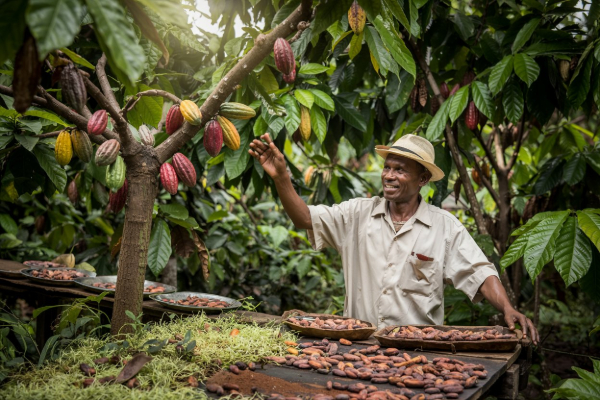
The drop in exports has been linked to new European organic import rules introduced in 2024.
The European Commission states that organic imports must now meet the same strict production and certification standards applied to farmers within the European Union.
Previously, many exporting countries operated under an equivalence system where their national rules were considered comparable to EU standards.
Under the updated framework, exporters must demonstrate full compliance with EU organic regulations and traceability requirements before products can enter European markets.
According to official European Union agriculture guidance, the new system aims to strengthen consumer confidence and ensure consistent organic quality across all markets.
However, the transition has reduced the number of farms able to qualify immediately for certification.
Organic cocoa farmland meeting EU standards in Africa fell to 238,258 hectares in 2024, down from 309,164 hectares the previous year.
This reduction reflects the adjustment period faced by farmers adapting to stricter certification requirements.
Sierra Leone Remains the Leading Exporter
Sierra Leone maintained its position as Africa’s largest organic cocoa exporter.
The country exported approximately 9,177 tons in 2024, making it the world’s second-largest supplier after the Dominican Republic.
Nearly 46 percent of Africa’s certified organic cocoa land is located in Sierra Leone.
Smallholder farmers dominate production in rural regions, where cocoa cultivation supports thousands of households.
The Democratic Republic of Congo ranked second among African exporters with shipments of about 4,609 tons.
Uganda followed closely with 4,580 tons exported during the year.
Other important exporters included São Tomé and Príncipe and Madagascar, both exceeding 1,000 tons in shipments.
Out of eleven organic cocoa-producing countries in Africa, ten exported cocoa in 2024. Cameroon was the only country without recorded exports.
Cocoa Regions Becoming Travel Destinations
While export volumes declined, interest in cocoa-growing regions is rising among global travelers.
Agricultural tourism is becoming increasingly popular, especially among visitors interested in sustainability and ethical food production.
Many cocoa-producing regions offer guided tours of organic farms and processing centers.
Travelers can observe the entire journey from cocoa pod harvesting to fermentation and drying.
Visitors often participate in hands-on activities such as bean sorting and chocolate tasting.
These experiences allow tourists to understand how organic certification standards affect farming practices and livelihoods.
Government Support for Agro-Tourism
Several African governments promote agricultural tourism as part of rural development strategies.
According to the Uganda Tourism Board, agro-tourism helps diversify tourism beyond wildlife safaris while supporting local communities.
Farm visits provide visitors with authentic cultural experiences and direct engagement with farmers.
Government tourism initiatives encourage community-based travel that benefits rural economies.
In Sierra Leone, tourism authorities promote eco-tourism and cultural heritage experiences linked to farming communities and forest landscapes.
These initiatives make cocoa-growing regions attractive destinations for travelers seeking meaningful experiences.
A Unique Chocolate Travel Experience
Cocoa tourism offers travelers a different perspective compared with traditional city tours.
Visitors explore forested landscapes where cocoa trees grow beneath shade canopies.
Guides explain organic farming techniques such as natural pest control and soil conservation.
Travelers also learn how international organic certification influences production methods.
Chocolate tasting sessions often include locally made products not available in international markets.
Many visitors describe cocoa tours as educational and deeply personal experiences.
Best Time to Visit Cocoa Regions
The best time to explore cocoa farms often coincides with harvest seasons.
In many West and Central African countries, the main harvest runs from October to March.
During this period, farms are active and visitors can see harvesting and fermentation processes.
Dry seasons also make travel easier, especially in rural areas.
Travelers should plan visits with local guides or tour operators familiar with farming communities.
Africa’s Cocoa Future and Travel Potential
Africa remains the world’s most important supplier of organic cocoa despite the recent decline in exports.
Farmers are gradually adapting to the new European certification rules.
As compliance increases, export volumes could recover in the coming years.
At the same time, cocoa-growing regions are gaining attention as emerging travel destinations.
For global travelers, organic cocoa landscapes offer a rare opportunity to connect agriculture, culture, and sustainability.
These destinations allow visitors to follow chocolate’s journey from tropical farms to international markets.
The evolving cocoa industry is not only reshaping trade patterns but also creating new travel routes across Africa.
Do you like this personality?
The post Stricter EU Organic Rules Slow Africa’s Cocoa Exports — Why Chocolate Trails Are Emerging as New Travel Experiences appeared first on Travel And Tour World.
