
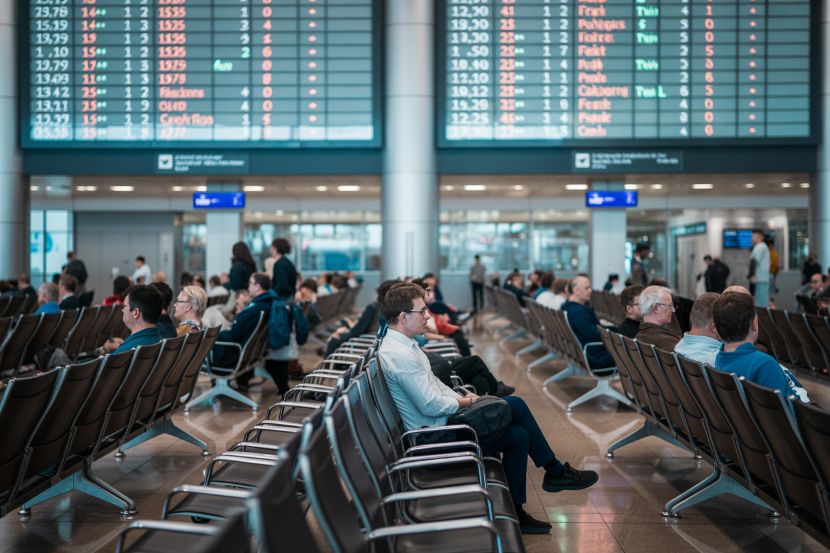

For weary travellers at Washington Dulles International Airport and Toronto Pearson International Airport, what was meant to be a day of journeys east, west, or across borders turned into a marathon of uncertainty, long waits, and emotional frustration. The two major hubs in North America reported a combined 1,152 cancelled flights and 157 delays, leaving families, business travellers and holidaymakers stranded in terminals across Virginia and Ontario. Many passengers described scenes of exhaustion and confusion as they struggled to find answers and alternate routes amid the operational breakdown.
At Washington Dulles, airline counters were congested with upset passengers seeking rebooking support after 567 flights were cancelled and 11 delayed, according to aggregated airport scheduling data. At Toronto Pearson, Canada’s busiest airport, travellers faced similar disruption with 585 cancellations and 146 delays, creating gridlock across departure halls and customer service desks. The combined figures underscore how two of North America’s busiest gateways buckled under pressure on a day when millions of travellers expected smooth passage.
Government Oversight and Aviation Reporting at Key North American Airports
Across North America, aviation performance and consumer protection are overseen by government agencies that publish official data on airline and airport punctuality. In the United States, the Bureau of Transportation Statistics (BTS) and the Federal Aviation Administration (FAA) monitor flight cancellations and delays through periodic reports that help passengers understand carrier performance and raise accountability. These government datasets provide transparency about how often flights are cancelled or delayed, and highlight trends in airport operations.
Similarly, in Canada, Transport Canada works alongside the Canadian Transportation Agency (CTA) to ensure that airlines and airports meet service standards and that passengers are informed about their rights when travel is disrupted. Under Canadian aviation consumer protection frameworks, passengers are entitled, in certain circumstances, to cash compensation, reimbursement for expenses, and re‑routing options when flights are cancelled or significantly delayed.
These government frameworks do not eliminate disruptions, but they set expectations and entitlements for travellers when disruptions occur, providing clarity and potential redress when operations falter.
A Day of Disruption: What Happened at Washington Dulles
As early flights pushed into the morning schedule at Washington Dulles, passengers queued in anticipation of departures to domestic and international destinations. But as announcements rolled across loudspeakers, it became clear that the day would not unfold as planned. A wave of cancellations — totalling 567 flights — hit major carriers at the airport, affecting routes to cities across the United States and abroad. Only a handful of flights registered delays that day, suggesting that cancellations were the dominant disruption.
Travellers bound for business hubs such as Chicago, Atlanta, and New York reported receiving scant information about options for rebooking, with many forced to wait hours before airline representatives could assist them. For families with small children, the uncertainty of when they might be re‑routed or compensated added an emotional strain to an already stressful experience.
Toronto Pearson’s Turbulent Travel Day
At Toronto Pearson International Airport, the disruption was no less severe. With 585 flights cancelled and 146 delayed, the airport became the epicentre of travel frustration in Canada. Departure boards flickered with rescheduled times, while long lines formed at information and service desks. Many travellers attempting to reach destinations throughout Canada and transcontinental hubs found their plans abruptly halted.
One passenger, scheduled to fly from Toronto to Vancouver for a family reunion, described her experience as “nothing short of chaos,” emphasising the emotional toll of cancelled flights and unanswered questions. Others voiced concern over missed connections and the ripple effect that a single cancelled flight could have on onward travel arrangements.
Human Impact: Frustration, Missed Commitments and Exhausted Passengers
The human stories emerging from the terminals highlight how deeply travel disruptions can affect everyday lives. Business travellers missed critical meetings; parents rearranged childcare schedules; and tourists watching weather forecasts from their departure lounges faced the very real possibility that their holidays might begin on a sour note.
Despite the frustration, many passengers praised frontline staff at both airports for their efforts to manage the complexity of rescheduling thousands of travellers. But the overarching sentiment remained one of disappointment, with travellers wondering whether better planning, staffing, or real‑time communication could have eased the day’s disruptions.
Airlines and Airport Responses
In response to the unfolding situation, airline and airport authorities issued statements expressing regret for the inconvenience and promising to address passenger concerns. Washington Dulles airport officials acknowledged the unexpected surge in cancellations and emphasised their commitment to restoring schedule normalcy as quickly as possible. They encouraged passengers to check flight statuses regularly and to contact airlines directly for the most up‑to‑date information.
Similarly, Toronto Pearson airport representatives urged travellers to stay informed through official airport announcements and to utilise self‑service tools for rebooking and refunds. They reiterated their dedication to enhancing customer service capacities during peak disruption periods and improving communication through digital channels.
Both airports stressed the importance of proactive engagement by travellers, noting that many disruptions stem from issues beyond the immediate control of the airport itself — including crew shortages, late‑breaking weather events, and logistical challenges faced by individual airlines.
Why Cancellations and Delays Still Happen
In the modern era of air travel, cancellations and delays remain common despite advances in scheduling technology and airport infrastructure. Several factors contribute to such disruptions:
- Weather conditions can prompt safety precautions and sudden schedule changes.
- Crew availability and regulatory limits on duty hours can affect whether airlines can staff flights.
- Maintenance requirements may sideline aircraft with little notice.
- Air traffic volume, particularly at major hubs, can exceed available capacity at peak times.
While many disruptions are unavoidable, they reveal ongoing vulnerabilities in the system and show why governments and airlines invest in contingency planning and consumer protection frameworks.
Passenger Rights: What Travellers Should Know
Whether in the United States or Canada, passengers affected by cancellations and long delays have rights under aviation consumer protection rules. These may include:
- Re‑booking on the next available flight without additional cost.
- Refunds for unused portions of travel when disruption is significant.
- Meal and accommodation support during prolonged delays.
- Financial compensation under specific regulatory circumstances.
Passengers are advised to retain travel documents, boarding passes, and any official notifications of disruption, as these can support claims for compensation or reimbursement after the fact.
Final Thoughts: Beyond the Terminal — Resilience and Adaptation
For everyone caught up in the wave of disruption at Washington Dulles and Toronto Pearson, the travel day will be remembered not as a smooth transition from point A to point B, but as a test of personal resilience. The frustration of cancellations and long waits weighed heavily on passengers, yet many adapted and found solutions amidst the chaos.
At its core, travel is about movement, connection and shared experience — and even when schedules falter, the human capacity to adapt remains strong. Passengers navigated changing flight boards, rebooked on the fly, and leaned on one another for support, demonstrating that even in moments of uncertainty, there is resolve, patience and a drive to reach their destinations.
In the end, the story of a disrupted travel day is not just one of cancelled departures and delayed departures. It is the story of people determined to move forward despite obstacles — a testament to the enduring spirit of travel in North America and beyond.
The post Thousands of Passengers Grounded in North America Today as Washington Dulles and Toronto Pearson Cancel 1,152 and Delay 157 Flights, Stranding Travellers in Virginia, Ontario, and Beyond appeared first on Travel And Tour World.
