
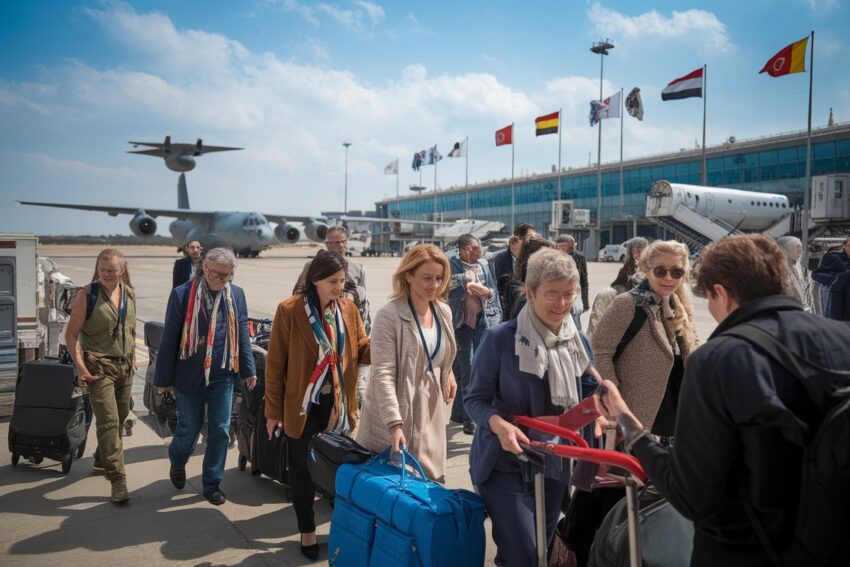

In a carefully coordinated operation, the Belgian Federal Public Service (FPS) Foreign Affairs and the Ministry of Defence, with European partners, have repatriated 198 Belgian nationals and 39 citizens from other European Union countries from the United Arab Emirates (UAE). This large‑scale evacuation underscores the Belgian government’s commitment to ensuring the safety of its citizens amid widespread flight cancellations and regional airspace restrictions in the Middle East. The operation faced logistical hurdles because most international flights from the Gulf region have been suspended due to ongoing tensions and airspace closures, complicating direct departures from the UAE. To overcome this, Belgium adopted a staged evacuation plan using transit hubs and overland transport before final flights home could be arranged.
Evacuation Routes: Muscat and Hurghada Play Central Roles
Belgian travellers were first moved by bus overland from Dubai and Abu Dhabi to Muscat, Oman, where commercial air traffic remains functional. From Muscat, evacuees were airlifted to Hurghada, Egypt, a safe departure point with regular flight connections to Europe. This two‑leg transit strategy allowed Belgium to avoid dangerous airspace and limited commercial flight options while still bringing large numbers of its citizens out of the region quickly. This overland‑to‑aircraft route was chosen after evaluations of safety and operational viability, according to government sources.
Military and EU Support Strengthens Repatriation Effort
Alongside diplomatic channels, the Belgian Ministry of Defence mobilised military transport aircraft to support the mission. This included tactical A400M transport planes and an Airbus A330 Multi Role Tanker Transport, enhancing capacity for evacuee transfers at designated safe hubs. Belgium also requested backing through the European Union’s Civil Protection Mechanism, enabling financial and logistical support across member states. Under this framework, Belgium and several other nations are sharing repatriation flights and resources, ensuring seats on flights are available not only to Belgians but to other EU nationals as part of collective EU solidarity.
Registration and Prioritisation: Government Advises Travellers
Belgian authorities encouraged travellers in the affected regions to register on the official Travellers Online platform. This registration allows the foreign ministry to organise evacuation lists, coordinate overland transport, and issue support documents for transit through neighbouring countries. Officials emphasised prioritising temporary travellers, such as tourists and short‑term business visitors, in the evacuation process. Long‑term residents and expatriates are given lower priority, as resources are predominantly focused on those whose departure is most urgent due to disrupted civilian air travel conditions.
Early Return Flights and EU Cooperation
Before Belgium’s full evacuation flights were deployed, some citizens began to return through allied operations. A small group boarded a Dutch‑assisted flight from Muscat to Amsterdam Schiphol Airport, helping to kick‑start the repatriation sequence. Others were brought home with assistance from Luxembourg authorities, reflecting strong cooperation between European states in response to the crisis. This EU coordination exemplifies how nations share logistical capacity and resources in complex multinational extraction efforts — particularly when airspace restrictions and security risks make direct flights from crisis zones unfeasible.
Challenges and Government Warnings
Amid the repatriation, leaders described the situation as highly fluid and operationally demanding. Uncertainty over airspace clearance, transport permits, and shifting security conditions meant that evacuation schedules changed frequently, sometimes on short notice. Belgian Foreign Affairs officials acknowledged that while each citizen’s anxieties are understandable, safety and secure transit corridors were their top priority. The government reiterated that all efforts were being made to return people safely, even as global travel disruptions continued to affect the wider region.
Guide for Affected Travellers
Authorities provided guidance for those still awaiting evacuation, urging them to:
- Continue registration on official consular platforms.
- Prepare travel documentation and visas for safe countries en route.
- Monitor updates from Belgian diplomatic missions and EU partner announcements.
Many travellers were also advised to consider self‑booked commercial flights from transit hubs where possible, to accelerate their journey home once in Muscat or Hurghada.
Belgium’s Commitment to Citizen Safety
This mission represents one of Belgium’s largest recent emergency evacuation efforts and reflects the government’s dedication to citizen welfare amid global instability. In bringing home 198 of its own nationals and 39 EU citizens, Belgium showcased comprehensive planning, international cooperation, and adaptability in the face of rapidly evolving geopolitical risk. Every stage of the operation involved close coordination between diplomatic, defence, and civil protection authorities, alongside EU counterparts, demonstrating a united response to one of the most challenging repatriation scenarios in recent years.
The post Chaos in the Gulf as Belgium’s Life‑Saving Operation Airlifts 198 Nationals and 39 EU Citizens Out of UAE Conflict Zone via Muscat and Hurghada — An International Evacuation Story You Can’t Miss! appeared first on Travel And Tour World.
