
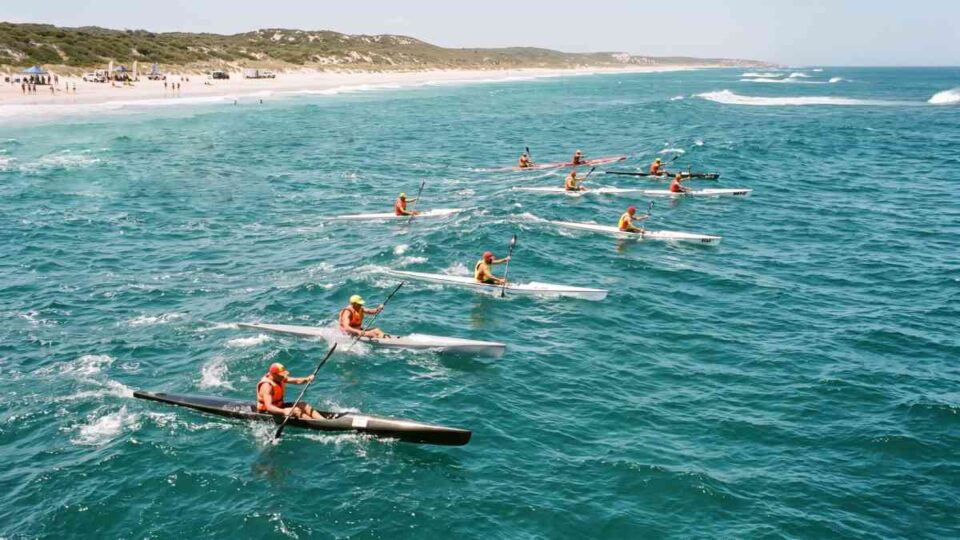

Sustainable regional prosperity in all coastal regions of Oceania is being realized through the deliberate development of maritime sports tourism. Mass sightseeing which has always been prone to the seasonal doldrums and low budget spending is increasingly being replaced by lucrative athletic events and endurance challenges. Coastal communities are earning handsome revenues by developing vibrant aquatic zones to conduct top-flight surfski marathons and surf lifesaving activities. Through the incorporation of elite events, mass involvement of participants, and community driven ocean management, the coastal locations of the Pacific and Indian Oceans are setting a lasting model of economic viability of the visitor industry.
The Structural Shift: From Passive Sightseeing to High-Yield Ocean Racing
The economic geography of Oceania has long been defined by its coastlines, yet a profound structural realignment has been experienced across the operational framework of coastal visitation. For decades, volume-based leisure travel was prioritised by destination marketing authorities across the Pacific and Indian Ocean seaboards, with reliance placed upon conventional sightseeing, day excursions, and static beachfront resort stays. While foundational visitor flows were established by these traditional models, host municipalities were exposed to acute seasonal volatility, severe infrastructure strain, and comparatively modest yields per visitor day.
Municipal and state investments have subsequently been redirected toward active, high-yield visitor segments through the convergence of sports tourism and the blue economy—defined by the Organisation for Economic Co-operation and Development and United Nations institutions as the sustainable utilisation of oceanic resources for economic expansion, improved livelihoods, and regional development. Approximately ten percent of global tourism expenditure is represented by active sports travel, with athletic travel expanding at an annual pace that consistently outstrips conventional leisure trips. It has been observed by UN Tourism that participatory sports travellers generate significantly higher daily expenditure, longer durations of stay, and deeper civic engagement within host communities compared to mass leisure sightseers.
Within Australia, the magnitude of this visitor economy has been documented by Tourism Research Australia. National benchmarks indicate that two hundred and fourteen billion dollars in total visitor expenditure was recorded across Australia, with eighty billion dollars secured by regional communities. Direct Gross Domestic Product of seventy-eight point one billion dollars is delivered by the tourism sector, representing two point nine percent of national economic output while sustaining more than seven hundred and thirteen thousand filled positions throughout the national workforce.
Under federal frameworks such as the Commonwealth’s THRIVE 2030 strategy, which targets two hundred and thirty billion dollars in visitor spend by 2030, and Tourism Australia’s Tourism 2035 roadmap, which targets up to sixty-nine billion dollars in international spend, an aggressive policy pivot toward High Yielding Travellers has been enacted. Within this operating environment, ocean sports tourism has been transformed from an informal aquatic pastime into an essential mechanism for state economic diversification and regional destination branding.
The Strategic Architecture of Oceania’s Ocean Sports Tourism Ecosystem
The elevation of regional water sports into premier international fixtures is facilitated by an integrated commercial and operational ecosystem. Rather than being staged as isolated community fixtures, event schedules are structured by destination planners around a coordinated value chain. Natural ocean environments are converted into commercial liquidity across four strategic pillars:
- Commercially Underwritten Prize Purses: Substantial prize pools ranging between one hundred and forty thousand and two hundred and ten thousand dollars are underwritten through corporate partnerships and state tourism grants, attracting world champions, international broadcast syndication, and high-value media reach.
- Multi-Tier Open Participation: Open-access racing divisions are integrated across junior, open, and masters categories in surfski, outrigger, and paddle craft, driving extended stays, craft freight logistics, and elevated accommodation spend.
- Intergenerational Mentorship Pathways: Scaled junior development and Nippers coaching clinics are delivered free of charge by world champions and Olympians, converting solo athletic trips into multi-generational family holidays.
- Shoulder-Season Smoothing: Major racing festivals are intentionally deployed during late-spring transition windows prior to peak summer school holidays, generating accommodation occupancy surges and stabilising regional hospitality employment.
Commercial benefits are thus systematically distributed across regional transport operators, accommodation providers, dining precincts, and local sporting associations.
Shaw and Partners WA Race Week: Flagship Model of Downwind Competition
The preeminent demonstration of this strategy in action is provided by Western Australia’s premier paddling festival, the Shaw and Partners WA Race Week, hosted annually along Perth’s northern coastal corridor in mid-to-late November. Centred at Sorrento Beach within the City of Joondalup, the festival has been established as the southern hemisphere’s benchmark for high-performance ocean competition.
The Rottnest Island to Sorrento Beach Ocean Crossing
The centrepiece of the festival is The Doctor, an internationally renowned twenty-seven-kilometre ocean marathon crossing navigated from Rottnest Island (Wadjemup) across the open Indian Ocean to Sorrento Beach. The race takes its title from the Fremantle Doctor, the reliable south-westerly sea breeze that sweeps across the lower Western Australian coastline throughout late spring and summer.
Consistent wind swells running parallel to the race trajectory are generated by this meteorological phenomenon, producing ocean downwind conditions that are celebrated internationally. Commencing from Thomson Bay on Rottnest Island, open shipping channels and deep maritime waters are navigated by competitors, demanding advanced technical wave-riding capability before a final surf transit is negotiated through the coastal break at Sorrento Beach.
Commercial Sponsorship and International Talent Migration
To lift a regional crossing into an internationally recognised competition, substantial commercial and state underwriting is mobilised. Through long-term title sponsorship from Shaw and Partners Financial Services and institutional support from the Western Australian Government via Tourism Western Australia, more than one hundred and forty thousand dollars in direct cash and prizes is awarded, with total series prize pools exceeding two hundred and ten thousand dollars.
A major international talent migration is stimulated by this financial backing. Elite participation has featured Australian four-time world champion Cory Hill besides triple women’s singles world champion Jemma Smith and South African world champion Kira Bester. Broad international media visibility is produced by the presence of premier international athletes from South Africa, Europe, North America, and the Pacific. Perth’s coastal assets are projected directly to adventure-travel demographics across key outbound visitor markets through international broadcasts, digital livestreams, and athlete-generated media channels.
Operational Logistics and Mass-Participation Frameworks
Complex marine transport and risk management systems are required to orchestrate an offshore crossing over twenty-seven kilometres of exposed ocean. Dedicated heavy-cargo sea barges departing from Fremantle are coordinated by event management authorities to transfer racing surfskis—often measuring up to six and a half metres in length and manufactured from ultra-light carbon composites—across to Rottnest Island. Simultaneously, competitors, race marshals, and technical support personnel are conveyed directly from Hillarys Boat Harbour to the island staging zone aboard chartered fast ferries.
Stringent marine safety regulations are enforced, requiring every competitor to be equipped with satellite-linked Personal Locator Beacons, marine safety whistles, high-visibility personal flotation gear, and craft leashes. Electronic athlete check-ins and live transponder tracking are maintained throughout the crossing, supported by volunteer surf lifesaving offshore watercraft and rigid-hull escort vessels.
While line honours are contested by elite athletes, the financial foundation of the festival is secured through its mass-participation format. Total craft entries are capped between four hundred and five hundred to preserve water-safety carrying capacity. A broad spectrum of divisions is contested, spanning Under-16, Under-19, Under-23, Open, and Masters categories from Over-40 through Over-70.
The program is further diversified through double surfskis, traditional spec craft, prone paddleboards, and multi-person outrigger canoes. A week-long schedule of secondary fixtures—including the eleven-kilometre Downwind International, the fast-paced Twilight Dash, and structured community warm-up runs—ensures that competitors travel with entourages and remain in host localities for seven to ten consecutive days, converting single-day visits into extended, high-spend regional holidays.
Grassroots Pathways and the Nipper Tourism Multiplier
The capacity of ocean sports tourism to bridge elite performance with grassroots participation represents a key operational differentiator. Unlike closed commercial sports leagues where rigid divisions separate athletes from spectators, an integrated intergenerational model is deliberately cultivated within coastal endurance disciplines.
A leading demonstration is provided by the Race One Nipper Clinic, hosted at Sorrento Surf Life Saving Club during WA Race Week. Direct instruction is provided to hundreds of junior surf lifesavers by world champions and Olympic kayakers free of charge. Practical coaching is delivered across ocean surf navigation, open-water craft control, wave transitions, and dynamic marine safety literacy.
From a destination planning perspective, several compounding economic multipliers are triggered:
- Party-Size Expansion: Junior competitors are invariably accompanied by family units, expanding average traveling parties from solitary competitors to multi-generational cohorts averaging three to four individuals.
- Extended Durations of Stay: Accommodation is routinely reserved across host precincts for five to nine consecutive nights by family travel groups attending development clinics while supporting relatives competing in masters or open divisions.
- Diffused Hospitality Expenditure: Sustained retail and dining trade is generated across local commercial hubs, including Sorrento Quay Boardwalk, Hillarys Boat Harbour, and secondary visitor attractions such as the Aquarium of Western Australia.
- Club Retention and Civic Capability: Deep community affinity and expanded surf lifesaving club memberships are fostered through junior engagement with international role models, thereby strengthening the volunteer safety foundations upon which future coastal fixtures rely.
The Economic Dividend of Volunteer Surf Lifesaving
The commercial expansion of ocean endurance fixtures across Oceania is sustained by the underlying volunteer operational capacity of surf lifesaving organisations. Marathons, downwind crossings, and ironman championships are made operationally viable through the facilities, rescue assets, and certified personnel provided by volunteer clubs.
The nationwide value of this network was quantified in comprehensive economic research conducted by Deloitte Access Economics on behalf of Surf Life Saving Australia. An estimated six point five billion dollars in net social and economic value is generated annually for the Australian community by surf lifesaving operations.
Over an evaluated fifteen-year horizon, a collective net economic dividend of ninety-seven billion dollars is delivered, underpinned by an exceptional benefit-cost return where more than twenty dollars in quantifiable economic, healthcare, and safety value is returned for every single dollar invested through government grants, commercial sponsorships, and donations.
More than one point three million hours of active coastal patrol are contributed by volunteer lifesavers each season, during which roughly twelve thousand ocean rescues and hundreds of thousands of preventative safety interventions are performed. It was established by economic modelling that more than thirteen hundred coastal drowning fatalities and over eight hundred permanent incapacitating injuries are averted annually by these operations.
Beyond preserving public aquatic safety, international perceptions of Australia as a professionally managed marine destination are reinforced. For event organisers and municipal authorities, this operational network supplies the marine risk mitigation and insurance compliance required to conduct high-risk open-water racing through exposed maritime channels.
Government Policy and Regional Investment Frameworks
Recognising the high-yield economic returns produced by coastal sporting festivals, overarching economic development policies have been aligned with ocean racing fixtures by Australian authorities.
Western Australia’s WAVES 2033 Strategy
Tourism has been formally designated as a key priority sector by the Western Australian Government under its economic framework, Future State: Accelerating Diversify WA. Structural expansion is guided by the Western Australia Visitor Economy Strategy 2033 (WAVES 2033), which is supported by an allocated investment of five hundred and thirty million dollars over four years. An annual visitor expenditure target of twenty-five billion dollars by 2033 has been set, expanding from a baseline of nineteen point five billion dollars.
The strategy is focused across four principal operational priorities:
- Direct event funding via Tourism WA’s Major Events and Regional Events programs to secure marquee sports fixtures.
- International aviation development through the seventy-five-million-dollar Reconnect WA fund to secure non-stop connections from key source markets across Asia, Europe, and North America.
- High-yield leisure targeting connected to the global destination campaign, Walking On A Dream, showcasing active coastal lifestyle assets.
- Infrastructure expansion facilitated by the Tourism Accommodation and Attractions Proposal initiative, supporting the development of coastal accommodation and tourism amenities.
Strategic Event Acquisition: The 2028 Australian Surf Life Saving Championships
State commitment to coastal sporting spectacles was demonstrated through an official ministerial announcement confirming that the Australian Surf Life Saving Championships will return to Western Australia in 2028, with nine consecutive days of national competition scheduled across Scarborough Beach and Trigg Beach.
It was noted by Premier Roger Cook that the return of the national championships in 2028 would deliver a substantial economic stimulus to local businesses while highlighting the state’s event-hosting capabilities and world-class coastal environments. The grassroots legacy and volunteer foundations of the event were similarly emphasised by Deputy Premier and Sport and Recreation Minister Rita Saffioti, who stated that widespread enthusiasm was felt regarding the return of the championships to Western Australian shores, enabling the state’s beaches to be showcased while celebrating the dedicated volunteer personnel who safeguard the coastline.
The milestone will coincide with the centenary of the Scarboro Surf Life Saving Club, established in January 1928, as highlighted by local parliamentary representative Stuart Aubrey. The event is slated to build upon the commercial legacy of the 2023 championships, which attracted more than five thousand interstate athletes and tens of thousands of travelling spectators to the Perth coastline.
Microeconomic Impact: Seasonality Smoothing in Coastal Precincts
Severe demand fluctuation represents a persistent commercial challenge for coastal destinations across Oceania. Pronounced trading peaks are experienced during peak summer holiday periods, followed by extended occupancy troughs throughout autumn, winter, and spring.
The scheduling of multi-day ocean racing fixtures during shoulder periods—such as mid-to-late November—serves as an effective counter-seasonal economic mechanism:
- Accommodation Compression: Occupancy spikes are generated across regional hotels and apartments at a time when corporate travel declines and summer family holidaymakers have not yet arrived. Commercial accommodation establishments across precincts such as Sorrento, Hillarys, and Scarborough consistently record high occupancy rates ranging between eighty-five and ninety-five percent.
- Elevated Expenditure Profiles: Active sports visitors display distinct commercial habits compared to leisure sightseers. Data compiled by Tourism Research Australia demonstrates that interstate sports travellers record average trip expenditures of one thousand five hundred and fifty-six dollars over five to nine nights. Daily spending is heavily directed toward local hospitality venues, equipment maintenance services, specialised nutrition, and vehicle hire.
- Workforce Stability: Stable customer volumes throughout November permit local retail, dining, and maritime transport enterprises to maintain full-time staffing rosters, mitigating reliance on seasonal casual labour and fulfilling core workforce retention objectives.
| Macroeconomic & Tourism Metric | National Benchmark (Australia) | Western Australian Indicator | Official Data Source |
| Total Visitor Spend | $214.0 billion ($80.0B in regional Australia) | $19.5 billion (targeting $25.0B by 2033) | Tourism Research Australia / Tourism WA |
| Tourism Contribution to GSP / GDP | $78.1 billion direct GDP (2.9% national share) | $16.6 billion direct GSP (3.3% state share) | Australian Bureau of Statistics / Tourism WA |
| Accommodation Occupancy Rate | 71.4% national average across commercial rooms | 77.5% – 79.7% annual average occupancy | Australian Accommodation Monitor |
| Filled Tourism Employment | 713,500 jobs nationally (4.5% of national workforce) | 106,800 filled jobs across WA | Tourism Research Australia / Tourism WA |
| Surf Life Saving Economic Value | $6.5 billion annual net economic and social return | Host to 2028 Aussies (4,500+ athletes) | Deloitte Access Economics / WA Government |
| Target Strategic Spend Horizons | $230.0 billion by 2030 (THRIVE 2030 roadmap) | $25.0 billion per annum by 2033 (WAVES 2033) | Austrade / Tourism Australia / Tourism WA |
Territorial Blue Governance and Environmental Stewardship
As active ocean tourism expands, the preservation of the marine environments underpinning these sporting disciplines is mandated. Guidelines established by the OECD for coastal regions highlight that commercial blue economy initiatives must balance commercial growth with environmental conservation, preventing shoreline congestion and ecological harm.
Non-motorised disciplines such as surfski racing, ocean kayaking, and surf paddling offer an inherently sustainable recreation framework. Because craft are propelled entirely by human physical effort and ocean wind energy, maritime carbon emissions are eliminated, fuel runoff is avoided, and acoustic disturbance across sensitive marine habitats is virtually absent.
At events such as The Doctor, environmental protocols are enforced in coordination with the Rottnest Island Authority. Strict conservation mandates are applied across the Class-A reserve:
- Racing craft staging is restricted exclusively to designated beach zones within Thomson Bay to prevent the erosion of dune vegetation.
- Single-use plastics, unmanaged transit foam, and packaging waste are strictly prohibited from entry onto the island.
- Support vessels and transport ferries are required to adhere to stringent marine biosecurity measures to safeguard nearshore reefs and marine fauna.
By aligning major ocean events with standards certified by Ecotourism Australia and the Global Sustainable Tourism Council, coastal waters are showcased without degrading primary natural capital, reinforcing non-motorised ocean sports as a sustainable model for coastal regional development.
Future Trajectory: Charting Oceania’s Maritime Sports Economy to 2035
The long-term outlook for maritime sports tourism across Oceania is supported by strong strategic growth drivers:
- Brisbane 2032 Infrastructure Pipeline: Capital investments into aquatic facilities, sports science, and high-performance development ahead of the Brisbane 2032 Olympic and Paralympic Games are expanding regional capacity while elevating international awareness of Australian coastal sporting culture.
- High-Definition Digital Broadcasting: Livestream broadcasts incorporating satellite tracking, offshore drone footage, and real-time biometric metrics have transformed ocean marathons into compelling visual media, connecting overseas audiences across North America, Europe, and South Africa directly with regional coastal destinations.
- Coordinated Trans-Oceanic Circuits: Race calendars are increasingly harmonised across Western Australia, Queensland, New South Wales, New Zealand, and Pacific Island nations, allowing competitors to complete multi-week competitive circuits rather than isolated individual fixtures.
- Data-Led Public Investment: High-participation coastal events will continue to be prioritised for regional development funding, supported by quantifiable returns such as surf lifesaving’s substantial economic dividend and elevated visitor expenditure.
By converting prevailing ocean conditions into structured competition grids, providing open community divisions, fostering youth mentorship, and enforcing strict environmental safeguards, coastal destinations across Oceania have established a benchmark for modern visitor economy management.
A paradigm-changing growth pattern for economic development in Oceania regions is defined through the development of ocean sports tourism. With the natural ocean swell being transformed into sustainable tourism spending, seasonality issues have been successfully mitigated. Through the assistance of volunteers and policies, coastal destinations can be considered front-runners in the global blue economy.
The post Australia’s Coastal Tourism Gets a Major Boost From Surfski and Surf Racing appeared first on Travel And Tour World.
