
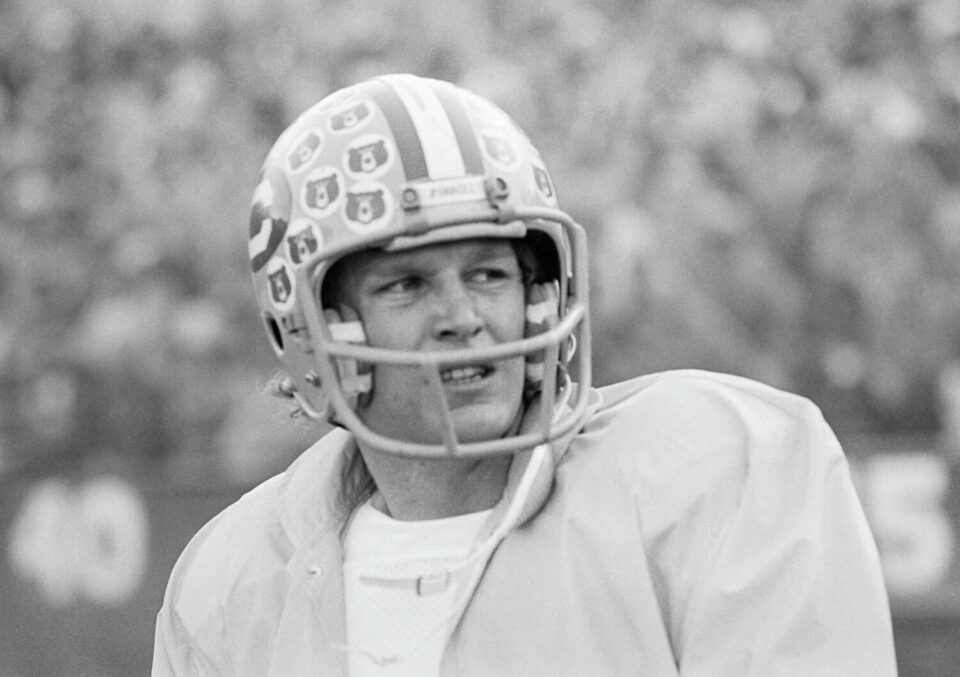

There’s a reason Joe Roth has the only retired number in Cal football’s history.
Following a prolific junior season that saw him lead the Golden Bears to the best offense in all of college football and a Pac-8 co-championship, Roth entered his senior campaign a Heisman favorite and the likely first pick in the 1977 NFL Draft. Just two games into his final season, Roth was diagnosed with a recurrence of melanoma – a cancer he’d hoped he’d beaten a couple of years earlier. He kept the terminal diagnosis to himself as it ravaged his body during a final year that saw him improbably finish ninth in the Heisman voting while he was fighting the disease.
News of his condition finally leaked two months after the season ended while he was preparing for a college football all-star bowl game in Japan. After the bowl, he spent time at UC San Francisco getting chemotherapy before doctors suggested amputating both of his legs to keep the cancer at bay. Roth declined, checked himself out of the hospital on Feb. 18, 1977, and, upon returning to Berkeley, was carried up three flights of stairs by his teammates to his apartment. Roth died the next day.


Roth’s courageous story united the college and led to a yearly Joe Roth Memorial Game in Berkeley (played between Cal and UCLA or USC annually until the Bears moved to the ACC), a fund that has supported countless Cal football scholarships through the years (and currently supports two full-ride football scholarships each season), as well as a Joe Roth team award for the player who best demonstrates courage, attitude and sportsmanship.
This season, nearly 50 years later, it also led to the first-ever Joe Roth Collection, a capsule of three shirts celebrating Roth, including one with his face on it – the first time his likeness has ever appeared on Cal merchandise, Associate Athletics Director Jonathan Okanes confirmed to SFGATE. The collection was heavily marketed by the athletic department ahead of the return of the Joe Roth Memorial Game on Sept. 5 – Cal’s season-opening 45-24 loss to UCLA – and sold both at the stadium and at the Student Store on campus.
To the surprise of Tom Roth, Joe’s now 82-year-old brother, none of the proceeds from the Joe Roth Collection go back to melanoma cancer research or even to the Joe Roth scholarship fund. Cal instead is pocketing all of the revenue, and Roth hasn’t heard from Cal for months since the school first contacted him about the Roth Collection.
View this post on InstagramA post shared by Cal Athletics (@calathletics)
“I haven’t heard from the university in quite some time,” Roth told SFGATE via phone.
According to Okanes, there was a text exchange with Roth and an athletic department staffer about the collection that ended on July 2. There hasn’t been any communication since, including leading up to the Joe Roth Memorial Game against UCLA or after the launch of the collection.
Equally surprised was Menlo Park’s Bob Rider, the Bay Area filmmaker behind “Don’t Quit: The Joe Roth Story” – an award-winning documentary about Roth’s life. Though, Rider said his greater surprise is that someone reached out to Tom Roth at all – according to Rider, a different Cal football staffer told him that they thought Tom Roth was dead.

“I got a call from [Cal Football Director Of Career Development] Ron Coccimiglio – he was a freshman on the team when Joe was a senior – reaching out wanting to find out if there was anyone they could talk to about merchandising for the memorial game because he wanted to reach out,” said Rider, who became close with the Roth family during the making of the film. “And I said, ‘I’ll talk to Tom. He’s the guy to talk to about a licensing agreement. It’s easy to do, he’s gonna say yes, then he’ll sign something and you’re good.’ Then Ron said, ‘I think Tom’s dead.'”
Rider went into a mild panic after the call. First, he dialed Tom Roth’s number – no answer – then called Tom’s son, also named Joe Roth.
“Joe calls me back and says, ‘No, I was just with my dad this weekend,'” Rider said. “Then I finally talked to Tom. He’s alive, he’s still here.”
Rider’s best guess is that someone in the athletic department did a cursory Google search for Tom Roth and found a different Thomas Roth who lived in Washington and died in 2014. Joe Roth’s very-much-still-alive brother Tom, who lives in Seattle, said he never heard from Coccimiglio in the end.

“I think it’s disingenuous in this era,” Rider said, alluding to the NIL era, which has seen college football players personally generate millions of dollars for usage of their name, image and likeness. “At the end of the day, they can do what they wanna do.”
Several universities actively partner with and raise money for foundations or scholarship funds established in memory of college athletes who tragically died. At Wake Forest, the Demon Deacons have held a Brian Piccolo Cancer Fund Drive since 1980 with event shirts of Piccolo, who died at 26 of an aggressive form of testicular cancer. Along with a fun run and a dance-a-thon, Wake has generated more than $5 million for cancer research in four-plus decades. At Ole Miss, the Rebels license replica jerseys and custom apparel in honor of Roy Lee “Chucky” Mullins, who was paralyzed during a 1989 college football game and tragically died two years later due to complications from a blood clot. The licensing royalties help support the Chucky Mullins Memorial Scholarship fund, which has provided financial assistance for more than 125 Ole Miss students with physical disabilities or exceptional financial need through the years.
For his part, Tom Roth only wants transparency from Cal on where the Joe Roth Collection revenue is going and, of course, for his brother to be remembered.
“Support melanoma research, or drop it into the fund, and tell people what you’ve done,” Roth said. “The scholarship has been there since 1977. And there was lots of communication early, as you would know, but as 10 years go by, a little less. Then a little less. [Former Cal head coach] Mike White was a personal friend of mine. There’s a new coach now, there’s been a ton of coaches since. They get the benefit, but you can’t expect them to carry the torch and go crazy. Someone in the fundraising thing has to keep track.”
Tom Roth said he previously received yearly statements about the Joe Roth Memorial Scholarship fund, but somewhere along the way, he stopped receiving those as well. According to Okanes, they stopped doing printed reports in 2022 and went digital-only, unfortunately for the 82-year-old. “With that last printed report, donors were informed we were going digital only, and a QR code and url was included that took them to a form to submit an email address to be used for reports moving forward,” Okanes explained.

“I understand the university, the president turnover, Cal is now in the ACC,” Tom Roth said. “I get all that – over the years, you can’t pass this tiny thing along and have it be as good as it was with new people.”
Certainly not with major college football conference realignment.
One of the things lost to Cal’s move to the ACC in 2024 was the yearly cadence of the Joe Roth Memorial Game as USC and UCLA moved to the Big Ten. The game has been temporarily back thanks to a four-game, nonconference agreement with UCLA stretching through 2029. But assuming that isn’t renewed, or college football further realigns in 2030, it remains in a tenuous state – something that frustrates Tom Roth almost as much as the new collection.
“If I was the athletic director, I’d make it the second football game at home, play it before October, that’s the Joe Roth Memorial Game deal,” Roth said. “If it’s a temporary deal, it’s a slap-fix situation, and I’m not for that.”
After receiving SFGATE’s request for comment, Okanes said the university is now again trying to reach Tom Roth, who, as of this publication, remains alive and well.
Most Read
Crime |
Travel |
News |
Food |
Read our stories ad-free on the new SFGATE app.
This article originally published at Cal sure seems to be cashing in on the tragedy of quarterback Joe Roth.
