
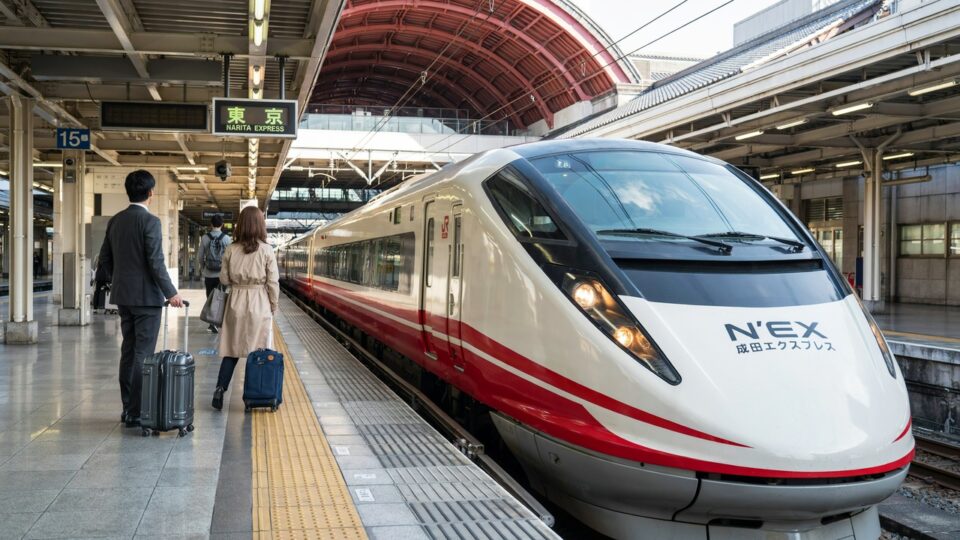

Japan’s East Japan Railway Company (JR East) will temporarily suspend sections of its Narita Express airport train service between Tokyo and Shinjuku or Ofuna from the evening of 6 November until the morning of 8 November 2026. The planned disruption follows intensive tunnel repairs on the Yokosuka Line and Sobu Rapid Line, with trains suspended between Tokyo and Shinagawa throughout Saturday, 7 November. The Japan Narita Express suspension November 2026 will affect passengers travelling between Narita International Airport and major Tokyo and Kanagawa destinations. However, airport express services between Tokyo Station and Narita Airport will continue, with alternative rail connections available.
JR East Confirms Narita Express Suspension Across Tokyo, Shinjuku and Ofuna Routes
JR East has confirmed a temporary change to Narita Express operations as part of a scheduled railway maintenance programme in the Tokyo metropolitan area.
The restrictions begin at approximately 7.40 pm on Friday, 6 November 2026, and extend until approximately 8 am on Sunday, 8 November, according to the railway operator’s published service notice.
These times refer to the affected Narita Express operating arrangements, measured around Tokyo Station. They do not mean that the entire Narita Express network will be closed throughout the period.
The main disruption will occur on Saturday, 7 November, when the Yokosuka Line between Tokyo and Shinagawa will remain closed from the first scheduled service until the last.
During this closure, Narita Express trains will operate between Tokyo Station and Narita International Airport rather than continuing to Shinjuku or Ofuna.
The maintenance programme will also affect passengers using the Yokosuka Line and Sobu Rapid Line for journeys across central Tokyo.
JR East has confirmed that the Yokosuka Line will turn back at Shinagawa towards Yokohama and Kurihama, while Sobu Rapid Line trains will terminate at Tokyo Station when travelling from the Chiba direction.
The railway operator intends to maintain its usual number of services on the unaffected sections.
This is a planned engineering closure rather than an unexpected railway failure, labour strike or airport shutdown.
When Will the Japan Narita Express Suspension November 2026 Begin and End?
The disruption covers three calendar days, but the restrictions differ considerably between Friday evening, Saturday and Sunday morning.
JR East has published train-specific details for the affected periods, allowing passengers to identify when their usual direct airport connection may be unavailable.
Official Railway Disruption Schedule
| Date | Period | Confirmed disruption |
|---|---|---|
| Friday, 6 November 2026 | From approximately 7.40 pm | Selected Narita Express trains terminate at Tokyo instead of continuing to Shinjuku or Ofuna |
| Saturday, 7 November 2026 | First train to last train | Yokosuka Line closed between Tokyo and Shinagawa |
| Saturday, 7 November 2026 | All day | Narita Express operates between Tokyo Station and Narita Airport |
| Saturday, 7 November 2026 | All day | Sobu Rapid Line turns back at Tokyo; Yokosuka Line turns back at Shinagawa |
| Sunday, 8 November 2026 | Early morning, until approximately 8 am | Selected Narita Express services retain altered western operating sections |
| Sunday, 8 November 2026 | Later services | Normal routing is scheduled to resume, subject to operational conditions |
The distinction between dates is essential for travellers.
Someone arriving at Narita Airport on Friday afternoon may experience normal services, while another passenger arriving later in the evening could need to change trains at Tokyo Station.
Similarly, passengers departing from Shinjuku on Saturday will not have their usual direct Narita Express service to the airport.
On Sunday morning, some services remain affected, but the restrictions are narrower than the full-day Saturday closure.
Passengers should therefore check their specific train number and departure time rather than relying only on the overall disruption dates. JR東日本:東日本旅客鉄道株式会社
Why Is JR East Closing the Yokosuka Line Between Tokyo and Shinagawa?
The temporary closure is necessary for concentrated tunnel repair and maintenance work on an important section of Tokyo’s railway network.
JR East originally announced the wider programme on 17 February 2026 as part of changes to its maintenance operations.
The railway company explained that traditional overnight maintenance periods provide relatively limited time for engineering teams to complete major repairs.
By introducing continuous working periods, the operator can undertake more substantial tasks without repeatedly opening and closing the railway.
The November closure is the third concentrated maintenance period scheduled for this section during 2026.
Previous closures were organised for 6 June and 5 September.
What Work Will Be Carried Out?
JR East’s engineering programme includes tunnel repairs and routine railway maintenance. The company has identified several types of work within its wider programme:
- Tunnel restoration: Repairing sections of railway infrastructure within the underground corridor.
- Sleeper replacement: Renewing components that support and maintain the position of railway tracks.
- Water leakage repairs: Addressing water penetration and deterioration within railway structures.
- General maintenance: Completing work needed to support railway reliability and operational safety.
- Mechanised construction: Using longer working periods to improve the efficiency of engineering activities.
The company has explained that concentrating work into longer periods can reduce the disruption associated with undertaking the same tasks over numerous shorter maintenance windows.
In its February announcement, JR East illustrated how a continuous working arrangement could provide approximately 1,680 minutes for certain engineering activities, compared with substantially shorter conventional working periods.
That figure was presented as an example of the engineering approach, not a guarantee that every repair task would require that amount of time.
The operator also identified workforce availability and changing working practices as reasons for reviewing its maintenance methods.
The principal objective is to support safer, more reliable railway services while creating a more efficient system for maintaining ageing transport infrastructure.
Will Narita Express Trains Continue Running Between Tokyo and Narita Airport?
Yes. JR East has confirmed that Narita Express trains will continue operating between Tokyo Station and Narita International Airport during the Saturday closure.
This is the most important detail for international passengers.
The maintenance work does not involve closing the railway between central Tokyo and Narita Airport.
Instead, the disruption affects the sections that normally allow certain Narita Express trains to continue westwards from Tokyo towards Shinjuku and Ofuna.
During the main construction period, Tokyo Station becomes the starting or finishing point for the affected airport express trains.
Passengers travelling directly between Tokyo Station and Narita Airport can therefore continue using the service.
JR East has stated that the normal number of Narita Express services will operate between Tokyo and the airport.
Nevertheless, passengers should consult the revised timetable because the departure stations and final destinations of individual services may differ from their usual arrangements.
The operator’s general Narita Express information identifies a fastest scheduled journey of approximately 53 minutes between Narita Airport and Tokyo Station.
That is an established fastest journey time, not a guaranteed journey duration for every service operating during the engineering weekend.
What Happens to Passengers Travelling Beyond Tokyo?
Passengers whose usual Narita Express service continues to Shinjuku, Shibuya, Shinagawa, Yokohama or Ofuna will need to consider alternative arrangements.
The most practical option for many journeys will be to transfer at Tokyo Station to another operating railway service.
However, the appropriate connection depends on the passenger’s starting point, destination and the route restrictions on the relevant day.
A transfer that normally takes only a few minutes may involve additional walking, waiting or changes of platform.
Travellers carrying large suitcases should allow extra time to move between stations and platforms.
JR East has not announced a universal replacement journey time for all affected passengers. JR-EAST
Narita Express Services Affected on Friday Evening, 6 November
The first significant changes begin on Friday evening, before Saturday’s full-day railway closure.
JR East has identified five Narita Express services departing Narita Airport that will terminate at Tokyo rather than continuing along their usual western sections.
These services are especially relevant to international passengers arriving at Narita Airport during the evening.
Confirmed Friday Evening Train Changes
| Train | Narita Airport departure | Tokyo arrival | Suspended continuation |
|---|---|---|---|
| Narita Express 46 | 6.45 pm | 7.45 pm | Tokyo–Ofuna and Tokyo–Shinjuku |
| Narita Express 48 | 7.17 pm | 8.13 pm | Tokyo–Shinjuku |
| Narita Express 50 | 7.49 pm | 8.51 pm | Tokyo–Ofuna and Tokyo–Shinjuku |
| Narita Express 52 | 8.44 pm | 9.40 pm | Tokyo–Ofuna and Tokyo–Shinjuku |
| Narita Express 54 | 9.44 pm | 10.38 pm | Tokyo–Ofuna and Tokyo–Shinjuku |
Times are from JR East’s published construction-specific timetable, in Japan Standard Time.
The table shows that passengers can still use these services to reach Tokyo Station.
The alteration concerns the onward section beyond Tokyo.
For example, someone travelling from Narita Airport to a hotel near Shinjuku Station on Narita Express 48 can reach Tokyo but must arrange a separate connection for the remaining journey.
A passenger heading to Yokohama or Ofuna will also need to examine alternative routes if their selected train no longer continues to those destinations.
The late-evening timing matters because travellers may have fewer onward services available as the night progresses.
International arrivals should consider the time required for immigration, baggage collection and travel to the airport railway station before selecting an onward connection.
Saturday, 7 November Will Bring the Widest Railway Disruption
Saturday is the central construction day and the period when the most substantial changes will apply.
JR East has confirmed that Narita Express trains will operate between Tokyo Station and Narita Airport throughout the day.
Services will not continue directly to the normal Shinjuku or Ofuna branches.
This affects passengers in both directions.
Those travelling from western Tokyo or Kanagawa towards the airport will need to reach Tokyo Station by another route before boarding Narita Express.
Passengers arriving from Narita Airport will need to leave Narita Express at Tokyo and make onward connections.
Selected Narita Express Departures from Tokyo on 7 November
| Train | Tokyo departure | Narita Airport arrival |
|---|---|---|
| Narita Express 1 | 6.18 am | 7.19 am |
| Narita Express 3 | 7.00 am | 7.58 am |
| Narita Express 5 | 7.31 am | 8.36 am |
| Narita Express 7 | 7.56 am | 9.02 am |
| Narita Express 9 | 8.30 am | 9.29 am |
| Narita Express 11 | 9.03 am | 9.58 am |
| Narita Express 13 | 9.30 am | 10.28 am |
| Narita Express 15 | 10.03 am | 10.58 am |
These are selected examples from JR East’s construction timetable, not the complete Saturday service list. Later departures are also scheduled.
For passengers with morning international flights, the important consideration is the additional journey needed to reach Tokyo Station.
Someone who would normally board Narita Express at Shinjuku will have to begin their journey with a separate train connection.
Likewise, passengers travelling from Yokohama or Ofuna should check the alternative services needed to reach Tokyo.
The published airport-bound timetable continues into the evening, with Narita Express 53 scheduled to leave Tokyo at 8.03 pm and reach Narita Airport at 9.13 pm.
Actual travel arrangements should be checked against the latest operating information before departure.
How Will the Yokosuka Line and Sobu Rapid Line Operate During the Closure?
The engineering work will interrupt the normal through-running connection between the Yokosuka Line and Sobu Rapid Line at central Tokyo.
These services are important for passengers moving between Chiba, central Tokyo and communities to the south, including parts of Kanagawa Prefecture.
JR East has confirmed that the two operating sections will be temporarily separated.
Changes to Yokosuka and Sobu Rapid Line Operations
| Railway service | Saturday operating arrangement |
|---|---|
| Yokosuka Line, Tokyo–Shinagawa | Suspended all day |
| Yokosuka Line, Shinagawa–Kurihama | Trains turn back at Shinagawa |
| Sobu Rapid Line, Tokyo–Chiba | Trains turn back at Tokyo |
| Narita Express, Tokyo–Narita Airport | Services continue at normal frequency |
| Narita Express, Tokyo–Shinjuku/Ofuna | Suspended throughout Saturday |
| Tokaido Line, Yamanote Line and Keihin-Tohoku Line | Available for alternative travel between Tokyo and Shinagawa |
Passengers who normally remain aboard a single train between Chiba and Yokohama may have to make an additional change in central Tokyo.
The railway company has identified the Tokaido Line, Yamanote Line and Keihin-Tohoku Line as alternatives for travelling between Tokyo and Shinagawa.
These routes provide a way around the closed section.
However, they are not identical to the suspended Yokosuka Line service, and journey times or platform arrangements may differ.
Importantly, JR East has stated that it will not provide formal alternative transport arrangements through other railway companies for this planned closure.
That does not mean other operators have stopped running their own trains. It means passengers should not assume that a ticket for an affected JR East service automatically provides free access to another company’s network.
Sunday Morning, 8 November Will See a Gradual Return Towards Normal Services
The main tunnel closure is scheduled to conclude before the Sunday morning operating period, but selected Narita Express services will still be affected.
JR East has published specific arrangements for Narita Express trains 1, 3, 5 and 7.
These services do not all follow the same pattern.
Confirmed Sunday Morning Arrangements
| Train | Departure point | Scheduled departure | Changed operation |
|---|---|---|---|
| Narita Express 1 | Tokyo | 6.18 am | Shinjuku/Ofuna–Tokyo sections suspended |
| Narita Express 3 | Shinjuku | 6.34 am | Ofuna branch suspended; additional Shinagawa stop |
| Narita Express 5 | Shinjuku | 7.07 am | Ofuna branch suspended; additional Shinagawa stop |
| Narita Express 7 | Shinjuku | 7.27 am | Ofuna branch suspended; additional Shinagawa stop |
These special arrangements demonstrate why the end of the full-day Saturday closure should not be confused with an immediate return to the normal timetable for every train.
Narita Express 3, 5 and 7 are scheduled to operate from Shinjuku on Sunday morning, with additional stops at Shinagawa.
However, their Ofuna sections remain suspended.
Passengers travelling from southern Kanagawa should therefore check their departure carefully, even if their journey begins after the central tunnel has reopened.
The railway operator expects normal operations to resume following the scheduled works, subject to the published train-specific restrictions and operating conditions.
How Can Travellers Reach Narita Airport from Shinjuku During the Suspension?
Passengers staying in Shinjuku will be among those most directly affected by the temporary loss of the usual Narita Express connection.
On Saturday, 7 November, travellers cannot board a direct Narita Express from Shinjuku to Narita Airport.
Instead, one option is to use the JR Chuo Line from Shinjuku to Tokyo Station before transferring to the airport express.
This involves an additional train journey and a change at Tokyo.
Travellers should check platform information and the total journey time using JR East’s official route planner.
Alternative Connections for Shinjuku Passengers
A practical route to consider is:
- Travel from Shinjuku to Tokyo Station using an operating JR service, such as the Chuo Line.
- Follow station signs towards the Narita Express platforms.
- Check the revised Narita Express departure time.
- Board the airport train for Narita Airport Terminal 2·3 or Terminal 1, as appropriate.
The route is an alternative travel suggestion, not a special replacement service established by JR East.
Passengers should also check whether their ticket covers the additional journey or whether an adjustment is required.
Tokyo Station is a major railway interchange, and moving between lines can take additional time, particularly when travelling with luggage.
For airport-bound journeys, it is sensible to select a connection that leaves sufficient time for transfers and airline check-in.
Travellers arriving from Narita and heading to Shinjuku can make the journey in the opposite direction.
What Are the Alternatives for Travellers from Yokohama and Ofuna?
Passengers in Yokohama and Ofuna will also lose their normal direct Narita Express connection during the main closure.
However, the broader railway network will continue operating.
The Tokaido Line offers an alternative connection between the Yokohama area and Tokyo Station.
Passengers travelling from Ofuna can also consider operating JR services that provide access to Tokyo.
The appropriate route will depend on the station, departure time and any other scheduled restrictions.
Suggested Journey Planning for Kanagawa Travellers
For an airport departure, the journey may involve travelling from Ofuna or Yokohama towards Tokyo Station before transferring to Narita Express.
Passengers starting at Shinagawa can use an operating service between Shinagawa and Tokyo, rather than attempting to board Narita Express at Shinagawa on Saturday.
Those travelling from more distant parts of Kanagawa should review their entire route, including the journey needed to reach the main railway network.
The maintenance notice does not establish a universal additional journey time for these connections.
Travellers should therefore avoid assuming that the journey will take the same amount of time as the normal direct airport train.
Could Keisei Railway Provide Another Route to Narita Airport?
Narita International Airport’s official transport guidance identifies Keisei Railway as another important rail operator serving the airport.
The Keisei network operates separately from JR East’s Narita Express.
Its services include the Skyliner, Access Express and Keisei Main Line.
These provide connections between Narita Airport and destinations including Nippori and Keisei Ueno.
For travellers staying in northern Tokyo, these routes may provide useful alternatives.
However, using Keisei will not necessarily remove the need for a transfer when travelling from Shinjuku, Yokohama or other locations outside its principal operating corridors.
Main Airport Rail Options
| Service | Principal connections | Consideration |
|---|---|---|
| JR Narita Express | Narita Airport–Tokyo | Continues during the engineering closure |
| Keisei Skyliner | Narita Airport–Nippori–Keisei Ueno | Alternative airport railway |
| Keisei Access Express | Narita Airport and stations on the Keisei/connected network | Check individual service destination |
| Keisei Main Line | Narita Airport and stations including Keisei Funabashi | Stopping pattern and journey time vary |
| JR conventional rail | Narita Airport and parts of the Tokyo metropolitan network | May require transfers |
These are established airport transport options, not newly announced replacement trains.
Narita Airport’s official website provides information about each railway operator, ticket purchasing and access to airport terminals.
Passengers considering a change from JR East to Keisei should check separate ticket conditions and any required additional payment. NARITA INTERNATIONAL AIRPORT
Narita Airport Terminal Access Remains Available During Railway Engineering Work
The Narita Express disruption does not mean Narita International Airport itself will close.
There has been no announcement from JR East that the tunnel repairs require the suspension of airport flight operations.
The engineering work is located on the Tokyo–Shinagawa railway section, well away from the airport.
Narita Airport’s official railway information identifies two principal JR and Keisei station locations serving its passenger terminals.
Narita Airport Station serves Terminal 1.
Airport Terminal 2·3 Station serves Terminals 2 and 3.
The airport states that Terminal 1 is approximately a five-minute walk from its railway station.
Terminal 2 is also approximately five minutes from its station, while Terminal 3 is approximately ten minutes away.
These are airport guidance estimates, not guarantees for every passenger.
Travellers should consider the time needed to move through the terminal, reach check-in areas and complete security procedures.
Passengers with mobility requirements or significant luggage should consult the airport’s accessibility information.
What Happens to Passengers Holding Reserved Narita Express Tickets?
Passengers who already hold tickets for affected Narita Express services should review their reservations before travelling.
The railway’s notice confirms that certain sections will not operate, but it does not establish a single automatic refund or rebooking arrangement applicable to every possible ticket.
The correct action may depend on the type of ticket purchased, the original journey and the section affected.
A passenger booked between Narita Airport and Tokyo may still be able to use the service as planned.
Someone booked from Narita Airport through to Shinjuku may instead need to travel only as far as Tokyo before using another train.
Ticket and Reservation Checks
Passengers should check the following:
- Whether their original Narita Express train is still operating.
- Whether the booked boarding or destination station has changed.
- Whether their seat reservation remains valid for the revised journey.
- Whether they need to amend a ticket that includes a suspended section.
- Whether their travel pass or ticket covers the alternative rail connection.
- Whether any applicable refund or exchange must be handled before departure.
JR East provides customer support and ticketing information through its official channels.
Travellers should not assume that a cancelled section automatically results in compensation for unrelated flights, hotel bookings or other travel arrangements.
JR East’s published passenger guidance also makes clear that missed-flight reimbursement is not generally provided simply because a train is delayed or suspended.
The distinction between the railway ticket itself and other travel expenses is important for passengers arranging international connections. JR-EAST
JR East Explains Special Green Car Arrangements During the Tokyo–Shinagawa Closure
The maintenance programme also affects passengers using Green Cars on conventional JR railway services.
Green Cars provide a higher-comfort accommodation category on selected local and rapid trains.
JR East has announced arrangements for travellers who would normally use the Yokosuka Line Green Car service across the closed Tokyo–Shinagawa section.
Passengers may transfer to Green Cars on the parallel Tokaido Line or Ueno–Tokyo Line where applicable.
For example, JR East identifies passengers travelling between Funabashi and Kamakura as a group that can use a connecting Green Car service between Tokyo and Shinagawa.
Those using a Suica Green Car ticket must follow the required onboard validation procedure when changing trains.
This includes touching the relevant Green Car information reader before and after transferring.
Travellers may also use the Yamanote Line or Keihin-Tohoku Line between Tokyo and Shinagawa.
However, JR East states that Green Car charges for that section will not be refunded simply because passengers choose these alternative services.
The operator also warns that Green Car pricing can differ depending on whether the passenger purchases tickets for separate sections or a continuous journey.
These rules apply to relevant conventional-train Green Car arrangements and should not be confused with the separate Narita Express limited-express reservation system.
Why This Matters
The planned Narita Express restrictions matter because they affect one of the main railway links between Japan’s largest metropolitan area and Narita International Airport.
Direct airport rail services simplify journeys for visitors unfamiliar with Tokyo’s extensive railway network.
When these services are temporarily shortened, passengers may need to navigate additional stations, platforms and ticketing arrangements.
The consequences are likely to be most noticeable for international visitors carrying luggage, families travelling with children and passengers with limited time before flights.
However, the disruption should not be interpreted as a complete loss of rail access to Narita Airport.
JR East is maintaining Narita Express services between Tokyo Station and the airport.
The wider significance lies in the balance between short-term passenger inconvenience and the railway maintenance needed to support reliable long-term operations.
JR East’s programme is designed to complete substantial repair work in concentrated periods, reducing reliance on repeated short overnight engineering windows.
The railway operator has not released a forecast of affected passenger numbers or estimated tourism losses specifically attributable to the November closure.
Any financial impact on tourism businesses therefore remains unquantified.
What Travellers Should Know
Passengers travelling through Tokyo between 6 and 8 November 2026 should check their entire airport transfer journey, particularly if they normally board Narita Express outside Tokyo Station.
The most important change occurs on Saturday, when direct Narita Express services from Shinjuku and Ofuna will not operate.
Before Booking or Travelling
- Confirm the date: The main closure takes place on Saturday, 7 November 2026.
- Check the time: Selected services are affected from Friday evening until Sunday morning.
- Verify the station: Tokyo Station remains the principal Narita Express departure and arrival point during the main disruption.
- Plan transfers: Use operating JR services to reach Tokyo from Shinjuku, Shinagawa, Yokohama or Ofuna.
- Allow additional time: Consider walking distances, luggage and possible waiting periods.
- Check reservations: Review tickets for services normally continuing beyond Tokyo.
- Consider other airport rail operators: Keisei provides separate services to Narita Airport.
- Monitor updates: Consult JR East’s current operating information before departure.
Travellers should also confirm their airport terminal before selecting a railway service.
Those travelling on international flights should follow their airline’s recommended airport arrival and check-in times.
Frequently Asked Questions
When will Narita Express services be suspended?
Selected Narita Express services will be affected from approximately 7.40 pm on Friday, 6 November, until approximately 8 am on Sunday, 8 November 2026. The main restrictions apply throughout Saturday.
Will Narita Express run between Tokyo and Narita Airport on 7 November?
Yes. JR East has confirmed that Narita Express will continue operating between Tokyo Station and Narita Airport at its normal service frequency during the planned closure.
Can passengers travel directly from Shinjuku to Narita Airport?
Not on Narita Express during the main Saturday closure. Passengers should use another operating railway service to reach Tokyo Station or consider an appropriate alternative airport route.
Why is the Yokosuka Line closing between Tokyo and Shinagawa?
JR East is carrying out intensive tunnel repairs and maintenance work. The closure allows engineering teams to work continuously on the affected infrastructure.
Will normal Narita Express services resume on 8 November?
Normal operations are scheduled to return following the engineering work. However, selected early Sunday services will retain modified operating arrangements, including changes affecting the Ofuna branch.
Japan Prepares for Temporary Airport Rail Changes Before Normal Services Resume
The Narita Express service changes scheduled for 6–8 November 2026 represent a significant but temporary alteration to Tokyo’s airport railway connections.
JR East has confirmed that the central Yokosuka Line section between Tokyo and Shinagawa will close throughout Saturday to allow concentrated tunnel maintenance.
Although direct Narita Express connections to Shinjuku and Ofuna will be suspended during the main work, trains will continue running between Tokyo Station and Narita International Airport.
For international visitors and residents, the principal challenge will be arranging suitable connections around the closed section.
The railway operator has published detailed service information to help passengers prepare.
With normal operations scheduled to resume following the engineering programme, travellers should focus on checking their departure times, allowing for transfers and confirming the latest arrangements before beginning their journeys.
The post Japan Announces Major Narita Express Service Changes from November 6 to 8 as Tokyo Tunnel Repairs Disrupt Airport Rail Connections appeared first on Travel And Tour World.
